



 In this page
  In this page

TL;DR: Customer service reports turn support activities into actionable insights by tracking KPIs like first response time, resolution time, SLA compliance, ticket volume, and CSAT. They help teams spot bottlenecks, improve agent performance, prioritize fixes, and deliver faster, more consistent customer support at scale.
Every business depends on its customer service team to deliver fast, reliable, and consistent support.
Without clear visibility into performance, issues can go unnoticed, leading to slower response times, more unresolved tickets, and declining customer satisfaction.
A customer service report brings key metrics and trends into one place, covering agent performance, customer interactions, service standards, and operational bottlenecks.
These insights help you identify what’s working, pinpoint what needs improvement, and make data-driven decisions that strengthen your support operations.
In this blog, we’ll explore what customer service reports are, why they matter, and how to create them.
What are customer service reports?
A customer service report is a structured summary of a support team’s performance over a specific period.
It provides a clear, measurable view of support activities, customer interactions, and service productivity using reliable data.
These reports typically include information such as customer complaints, resolution details, service outcomes, and customer feedback, along with key performance metrics that support data‑driven improvements in service quality.
How customer service reports improve satisfaction and support performance
Customer service reports provide actionable insights into customer interactions, agent productivity, and overall support performance.
With these insights in place, customer service reports contribute to better support performance in several ways, including:

Evaluates customer service quality
Customer service reports give managers a clear view of how well the team is performing against key metrics such as CSAT, first contact resolution, and resolution time.
This visibility helps identify where service is falling short and enables targeted improvements in processes, workflows, or agent performance.
Identifies recurring issues and customer pain points
By analyzing ticket trends, complaint categories, and support interactions, reports highlight recurring problems customers face.
These insights help teams address root causes, whether it’s a product issue, unclear documentation, or a workflow gap, leading to fewer repeated tickets and a smoother customer experience.
Improves agent performance and accountability
Customer service reports provide measurable benchmarks for individual and team performance.
Managers can identify coaching opportunities, balance workloads, and ensure agents meet service goals, while agents themselves can track progress and improve efficiency over time.
Optimizes workload and resource allocation
Tracking ticket volume, channel usage, and resolution rates helps teams understand demand patterns and workload distribution.
This makes it easier to allocate resources effectively, avoid customer service burnout, and ensure consistent support coverage across channels.
Enables faster, data-driven decision-making
Customer service reports consolidate performance data into a clear, structured view, making it easier for teams to act quickly.
Instead of relying on assumptions, leaders can prioritize improvements, adjust staffing, refine workflows, and implement changes based on real support data.
Strengthens customer retention
When teams respond faster, resolve issues efficiently, and eliminate recurring problems, overall service quality improves.
This leads to higher customer satisfaction, reduced frustration, and stronger long-term customer relations.
Tracks progress against service goals and SLAs
Customer service reports help teams monitor performance against predefined goals such as SLA compliance, response targets, and resolution benchmarks.
This ensures accountability, highlights performance gaps early, and keeps teams aligned with service standards.
What customer service reporting metrics matter most for performance?
To improve customer service, you need clear, reliable data. Reporting metrics help you understand how well your team is performing, where customers are struggling, and what changes will make the biggest impact.
Here are the key metrics every support team should track:
First response time (FRT)
First response time measures how long it takes for an agent to send the first reply after a customer submits a request.
Faster first responses reassure customers that their issue is being addressed and set the tone for a positive support experience.
Time to resolution (TTR)
Time to resolution measures how long it takes to fully resolve a customer issue, from the first message to the final fix.
Shorter resolutions improve satisfaction and show that your support processes are working efficiently.
Average handle time (AHT)
AHT captures the total time an agent spends handling a support request.
It includes everything from the initial interaction to completing follow-up steps. Tracking this helps teams understand workload and efficiency.
SLA compliance
Service level agreement (SLA) compliance measures how consistently your support team meets agreed‑upon service level targets, such as response and resolution times.
Tracking this metric helps teams identify missed commitments, address workflow bottlenecks, and ensure customer expectations are met consistently.
Low SLA compliance often signals staffing gaps, process inefficiencies, or uneven workload distribution, making it a critical metric for improving service reliability and accountability.
Ticket volume
Ticket volume reveals how many support requests your team is dealing with.
When compared with resolved tickets, it helps you assess capacity, team efficiency, and whether additional staffing or automation might be needed.
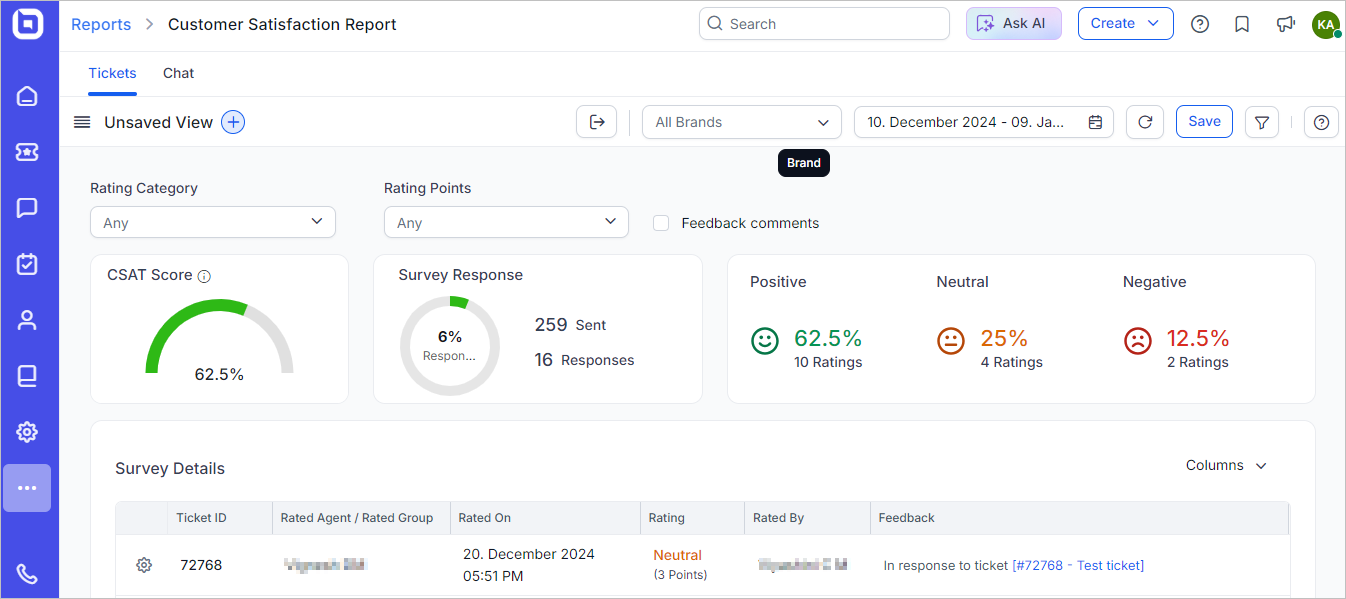
Customer satisfaction score (CSAT)
Customer satisfaction score shows how satisfied customers are with a specific interaction or overall service experience.
Low scores highlight areas that need attention, while consistently high scores indicate strong service and reliable processes.
First contact resolution (FCR)
FCR tracks the percentage of issues resolved during the very first interaction.
High FCR rates signal knowledgeable agents, efficient workflows, and a seamless customer experience.
Tips to create effective customer service reports
A well‑structured report on customer service provides visibility into support performance and helps teams uncover gaps that may otherwise impact service quality.
When done right, they ensure critical data is captured, analyzed, and acted on consistently.
The following strategies will help you create customer service reports that are accurate, actionable, and easy to use.
Establish clear objectives
Start by defining why you are creating the report and what you want to measure.
Clear objectives ensure the report focuses on the right customer experience metrics, such as response time, SLA compliance, or customer satisfaction.
Once objectives are set, you can collect relevant data and build reports that support meaningful evaluation.
Track relevant metrics
Not every metric belongs in every report. Select only those metrics that align with your goals to avoid unnecessary complexity.
This approach makes it easier to define customer service KPIs and track performance consistently.
Use effective visuals
Use charts, graphs, tables, scorecards, and dashboards to present data clearly and make trends easier to analyze and act on.
Clear visuals help teams quickly spot patterns, compare performance, and make informed decisions.
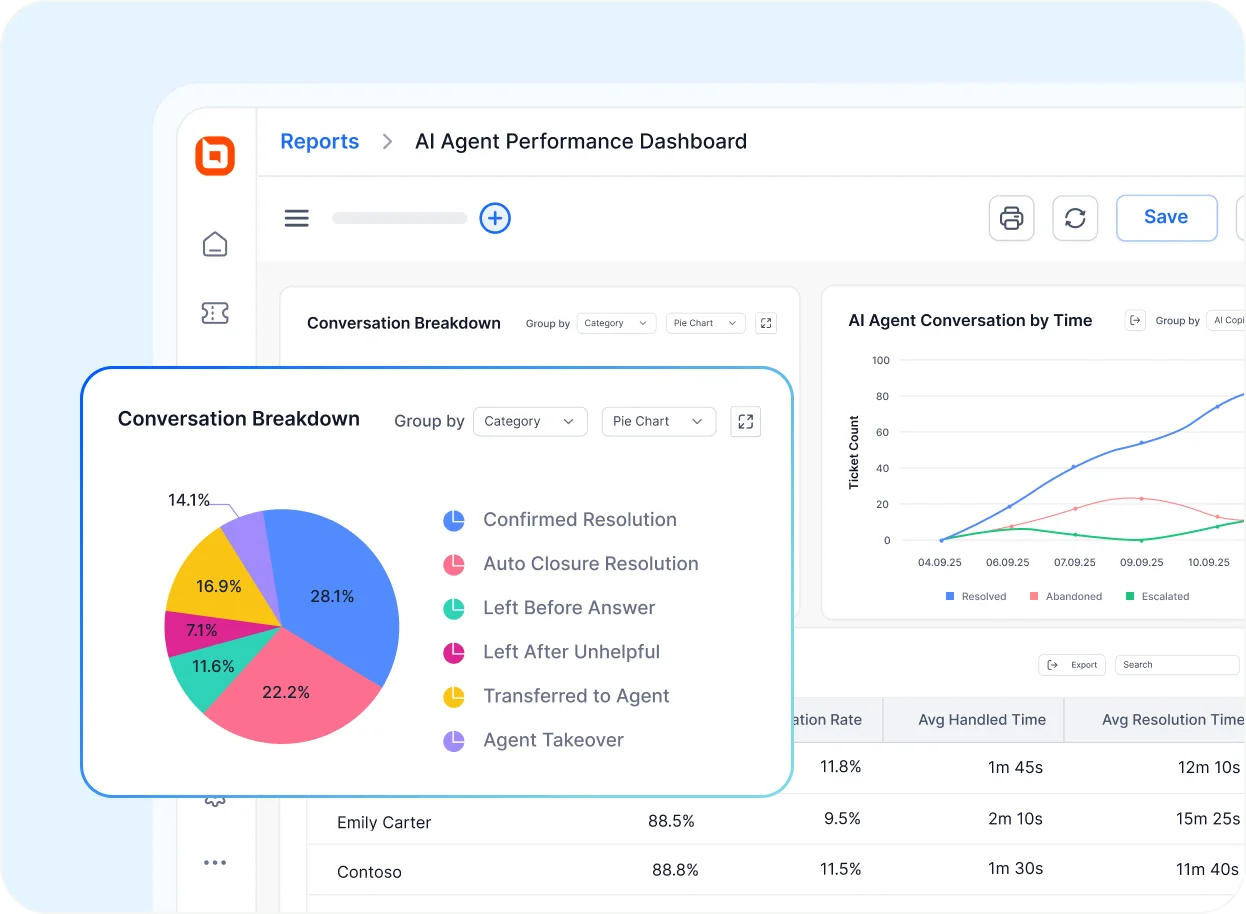
Performance Dashboard Showing Charts and GraphsYou can convert data into compelling graphic stories that promote proactive actions to drive growth and excellence for the support team.
Compare with historical data
To effectively identify current or future trends, it’s essential to carry out regular customer service reporting comparisons of current and past data.
For instance, even if your first response time is still below target, consistent improvement signals that changes are working and moving in the right direction.
You can make informed decisions that drive customer happiness and operational efficiency by continuously monitoring these trends.
Structure data and reports clearly
Organize reports with clear labels, logical sections, and consistent formatting.
A well‑structured report reduces data clutter, improves accuracy, and makes it easier to analyze, share, and store reports for future reference.
Strengthen data security
Customer service reports often contain sensitive information.
Restrict access to authorized stakeholders and use security measures such as access controls, single sign‑on (SSO), two‑factor authentication (2FA), and regular backups to protect valuable data.
Regularly review and update reports
Customer service needs change over time, and reports should evolve with them.
This ensures they remain relevant, accurate, and in line with business objectives.
Ongoing cross-team collaboration also makes it easier to incorporate new insights and improve processes.
Furthermore, scheduling meetings every month allows teams to integrate new insights, assess performance, and make necessary adjustments, such as implementing additional customer service training or simplifying procedures.
Use customer service reports to improve support performance
Your customers are at the heart of your business, and truly understanding their needs is essential for improving service quality and satisfaction.
Customer service reports provide visibility into performance, trends, and gaps, so you can improve workflows, coaching, and outcomes.
With BoldDesk, you can automate reporting, track key customer service KPIs, monitor SLA performance, visualize trends through dashboards, and collect targeted customer feedback, all in one platform.
Ready to turn your customer service data into actionable insights?
Schedule a live demo or start your 15-day free trial to see how we can help teams deliver faster, more consistent support.
If you have any questions, don’t hesitate to contact our support team for further guidance.
Related articles
- Easy Tips to Deliver Personalized Customer Service
- The Ultimate Customer Service Analytics Guide for 2026
- SMART Customer Service Goals: A Guide to Setting and Achieving Them
Frequently Asked Questions
An effective customer service report clearly shows support performance using measurable metrics such as response time, resolution rate, customer satisfaction, and agent productivity.
It highlights trends, identifies improvement areas, and provides actionable insights that help teams improve customer service experience and service quality.
Customer support reports improve ROI by identifying inefficiencies, reducing operational costs, and improving service outcomes.
By analyzing metrics such as resolution time, ticket volume, and customer satisfaction, businesses can optimize staffing, automate repetitive tasks, and allocate resources more effectively to increase customer retention and profitability.
A customer service report should always include clear objectives, relevant performance metrics, trend analysis, and actionable recommendations.
Key elements such as customer satisfaction scores, resolution metrics, and improvement actions ensure the report supports informed decision-making and service optimization.
Common types of customer service reports include customer satisfaction reports, agent performance reports, team performance reports, customer retention reports, and operational support reports.
Each report type focuses on specific service metrics to help businesses evaluate support effectiveness and improve customer experience.
Customer service reports should be updated regularly based on business needs, most commonly on a daily, weekly, or monthly basis.
Operational teams often use daily or weekly updates to monitor support performance, while managers and leadership rely on monthly reports to analyze trends and make strategic decisions.