


 In this page
  In this page

TL;DR: Customer service experience reflects how customers feel across every support interaction, from finding help to resolution and follow up. Great service is fast, clear, and empathetic, reducing effort and building trust. You can improve it with streamlined processes, meaningful metrics, and continuous, feedback driven refinement.
Every interaction shapes how customers perceive your business and can determine whether they stay or switch to a competitor.
Research by Zippia shows that 91% of customers are willing to switch companies after just one poor service experience.
Customer service experience is the overall impression customers form across every interaction with your support team, from first contact to issue resolution.
As customer expectations continue to rise, businesses must design support experiences that are fast, consistent, and empathetic.
With the right strategy, you can turn customer service into a competitive advantage that strengthens brand reputation and reduces revenue loss.
In this article, you’ll learn practical strategies to strengthen your customer service experience, plus examples and the benefits of implementing them.
What is customer service experience?
Customer service experience is the overall impression customers form from every interaction with your support team.
This includes:
- Finding help quickly through clear, accessible support options
- Pre-purchase questions handled by support
- Issue triage and routing
- Problem resolution
- Post-service customer follow-up, feedback, and relationship building
When companies consistently deliver strong customer service experiences, they strengthen brand reputation, while poor service leads to frustration, negative reviews, and customer churn.
Customer service experience vs customer experience
Customer service experience and customer experience are closely related but not the same.
Understanding the difference helps teams focus on improvements in the right areas and avoid misaligned strategies.
The table below summarizes the key differences between the two terms.
| Aspect | Customer service experience (CSX) | Customer experience (CX) |
| Scope | Focuses on support interactions and issue resolution | Covers the entire customer journey across all touchpoints |
| When it occurs | During and after a customer needs help | Before, during, and after purchase |
| Primary focus | Speed, accuracy, empathy, and resolution quality | Brand perception, emotions, and overall relationship |
| Owned by | Support and customer service teams | Company‑wide (product, marketing, sales, support) |
| Key metrics | CSAT, CES, FCR, resolution time | NPS, retention, churn, lifetime value |
| Goal | Resolve issues efficiently with minimal effort | Build long‑term loyalty and advocacy |
In short, customer service experience is a core component of customer experience.
While customer experience shapes how customers feel about your brand overall, customer service experience determines how they feel when something goes wrong or when they need help most.
Why delivering an exceptional customer service experience matters
Customer service experience shapes how customers judge your brand in the moments that matter most, including when they need help, answers, or a fix.
Offering the best customer service experience comes with the following advantages:

- Improves word-of-mouth and brand reputation: Customers who get quick, helpful support are more likely to recommend you publicly through reviews, social posts, and privately via referrals, strengthening trust in your brand.
- Reduces churn and protects revenue: Poor support creates strong negative emotions: Khoros reports 42% of customers feel disappointed, 43% unhappy, and 41% angry after a bad service interaction. Faster resolution and clear next steps reduce cancellations and silent customer churn.
- Builds trust and loyalty over time: Consistent ownership, clear communication, and reliable follow-through make customers feel valued, driving repeat purchases and long-term retention.
- Boosts employee confidence and performance: The right training, knowledge base, and tools reduce stress and repeat contacts, helping agents deliver better outcomes and more positive customer relations.
- Reduces support costs: Strong self-service content and clearer resolution paths help customers solve common issues independently. This lowers ticket volume and repeat contacts, so your team can support more customers without adding headcount.
Best practices to improve customer service experience
An exceptional customer service experience depends on how quickly customers get help, how much effort it takes, and how confident they feel in the outcome.
Use the following tips to reduce friction across channels, improve resolution quality, and build trust at every support touchpoint.
Understand customer needs
To improve service quality, start by clarifying what customers expect and where they get stuck. You can do this by:
- Collecting and analyzing customer feedback
- Sending customer satisfaction surveys
- Conducting interviews and market research
- Monitoring social media comments and mentions
Then turn insights into action by updating your knowledge base, refining routing rules, and improving the resolution of product issues.
Go beyond customer expectations
Exceptional service happens when you deliver more clarity, speed, and ownership than customers anticipate.
Small gestures can create lasting positive impressions and strengthen relationships.
To exceed expectations, businesses can:
- Proactively share next steps and timelines before the customer asks
- Offer a faster workaround while the full fix is in progress
- Follow up after resolution to confirm everything works
Build a customer-centric culture
A customer-centric culture ensures employees consistently make decisions that prioritize customer outcomes across every interaction.
To make customer‑first principles operational, organizations should focus on:
- Aligning company values, processes, and goals to customer outcomes
- Personalizing communication without sacrificing accuracy or consistency
- Reinforcing active listening and empathy in customer service through training, coaching, and quality reviews
- Defining what “good” looks like, including first-response targets, tone standards, escalation rules, and clear ownership expectations)
When expectations are explicit, and behaviors are reinforced, customer‑centricity becomes repeatable, measurable, and consistent across all touchpoints.
Empower your support team
Frontline agents deliver better service when they have the knowledge, permission, and confidence to act, without unnecessary handoffs.
Empowerment works best with guardrails, such as documented policies, defined escalation paths, and a shared source of truth like a knowledge base, so answers stay consistent across channels.
To empower them:
- Provide role‑specific training and ongoing coaching so agents understand products, processes, and resolution standards.
- Equip them with the right tools and resources, including ticketing automation, internal notes, and searchable knowledge bases.
- Define decision boundaries clearly, outlining what agents can resolve independently and when escalation is required.
- Reinforce ownership of customer interactions, from first response through final resolution.
Leverage AI and automation to enhance service quality
The right automation helps customers get timely, accurate support while reducing repetitive work for agents.
You can use automation to:
- Automate ticket routing and prioritization
- Use AI agents for instant answers to common questions
- Predict customer needs using usage and behavior patterns
- Send proactive notifications and updates
- Improve agent productivity with AI‑assisted responses
- Add human review or approval for sensitive cases, such as billing, cancellations, legal, and security
Offer proactive customer support
Anticipate the needs and concerns of customers throughout their journey and provide solutions to common difficulties that they may face. Employ preventive measures to minimize their impact.
Proactive customer service shows customers you’re solving problems before they escalate.
It reduces frustration through transparency and responsiveness.
This includes:
- Identifying repeat issues and publishing “known issues” updates
- Triggering proactive outreach for high-impact incidents
- Using customer onboarding and check-ins to prevent common setup mistakes
- Closing the loop by sharing what changed based on customer feedback
Provide seamless omnichannel support
Omnichannel customer service means customers can switch channels without repeating information, and your team keeps full context for smoother handoffs.

To meet this expectation:
- Offer support via email, live chat, social media, and web forms
- Keep service quality consistent across channels
- Provide 24/7 support where possible or set clear availability expectations
- Centralize customer conversations and standardize handoffs
What are the key metrics to measure customer service experience?
Understanding how customers perceive your service is essential for improving your support processes, identifying gaps, and strengthening overall satisfaction.
These customer service metrics provide clear insights into performance.
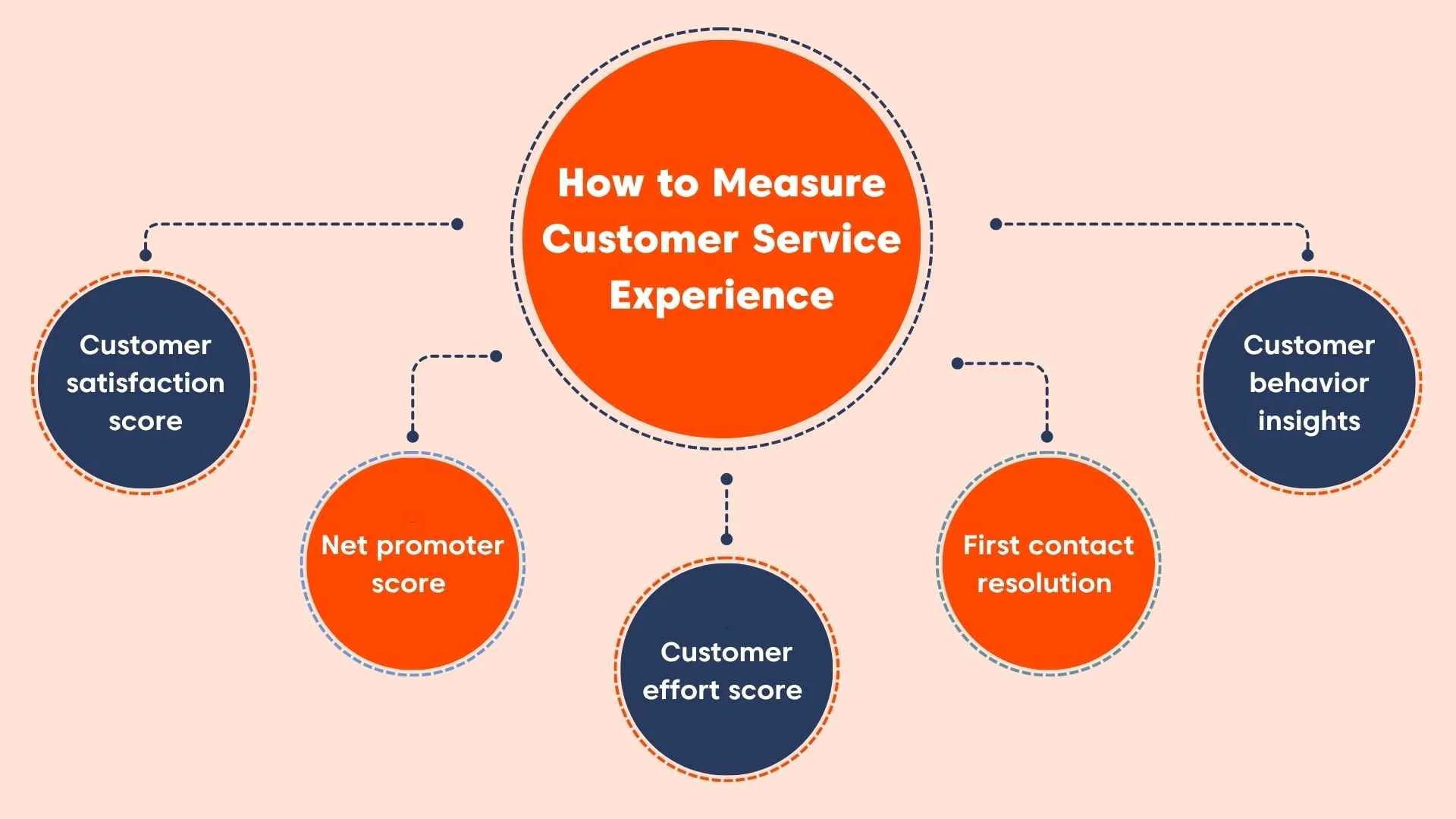
- Customer Satisfaction Score (CSAT): CSAT measures satisfaction right after a support interaction. High scores indicate a positive experience, while low scores show where support quality may need adjustment.
- Net Promoter Score (NPS): NPS evaluates how likely customers are to recommend your business to others. A high NPS signals strong loyalty, while a low score highlights dissatisfaction that may lead to churn.
- Customer Effort Score (CES): CES measures how easy it is for customers to get the help they need. Low effort scores correlate strongly with repeat business, while high effort signals friction in your service process.
- First Contact Resolution (FCR): FCR tracks how often customer issues are resolved during the first interaction. High FCR indicates effective support and reduces frustration caused by repeated follow‑ups.
- Customer behavior insights: Monitoring how customers navigate your website, use self‑service tools, and move across channels helps identify bottlenecks and common points of friction before they escalate.
Examples of great customer service experiences
Good customer service experiences usually share the same ingredients: fast response, clear ownership, low customer effort, and a recovery plan when something goes wrong.
The following are the real-life examples of businesses that have proved to offer the best when it comes to delivering customer service experiences.
Zappos: Proactive resolution and customer-first empowerment
Zappos is an online retailer for shoes and clothing that is known for its exceptional customer service.
Its agents are empowered to solve problems quickly without excessive approvals, so customers get a fast, confident resolution.
Here’s what Zappos does well:
- Empowers agents to make autonomous decisions
- Responds quickly to urgent situations
- Leads with empathy and “make it right” ownership
- Uses proactive service recovery to rebuild trust
Example:
A customer needed shoes for a time-sensitive event, but the shipment went to the wrong location. Support took ownership, expedited a replacement to the correct destination, and made a recovery gesture to reduce the customer’s risk and frustration.
Disney: Immediate accountability and meaningful recovery
Disney is known globally for its commitment to exceptional guest experiences and its ability to turn service issues into positive moments.
It handles issues with clear accountability and a recovery gesture that matches the customer impact, without making the customer fight for it.
Why Disney stands out:
- Trains staff on consistent service standards
- Escalates quickly when an issue is high-impact
- Takes accountability for service failures
- Uses recovery gestures to restore trust
Example:
After a guest reported a disappointing experience, the issue was escalated quickly, a leader apologized, and Disney offered a recovery gesture aligned to the inconvenience, turning a negative moment into a trust-building one.
Revive your business with an outstanding customer service experience
A strong customer service experience ensures customers get timely support, clear answers, and confident resolutions across every interaction.
When support teams respond efficiently and take ownership from first contact through follow‑up, businesses see stronger retention and more consistent service outcomes.
BoldDesk helps you put these best practices into action with automated ticketing, safeguards that prevent missed requests, and a user‑friendly knowledge base that ensures customers and agents always have access to the information they need.
Start your 15‑day free trial to experience how BoldDesk can transform your support workflow.
Prefer a walkthrough? Book a 30‑minute live demo. If you have any questions, our support team is always here to help.
Related articles
- Customer Service vs Customer Experience: Key Differences
- 9 Effective Customer Experience Optimization Strategies
- Customer Experience Analytics: Important KPIs and Use Cases
- 7 Best Ways to Utilize AI for Customer Experience
Frequently Asked Questions
Common mistakes include slow response times, inconsistent support across channels, poorly trained agents, unclear ownership, and failing to act on customer feedback.
These issues increase customer effort and often lead to dissatisfaction and churn.
Help desk software improves customer service experience by centralizing conversations, prioritizing requests, automating routing and follow-ups, and making performance visible through reporting.
This helps teams respond faster and deliver more consistent support as volume increases.
Technology improves customer service experience through automation, AI-powered assistance, omnichannel communication, and data-driven insights.
When used well, it reduces customer effort and helps teams resolve issues faster without sacrificing service standards.