



 In this page
  In this page

TL;DR: AI agents help businesses deliver faster, smarter customer service by resolving issues automatically, executing actions through APIs, and keeping conversations consistent. Unlike basic chatbots, they personalize support across channels, reduce escalations, and free human agents to focus on complex, high‑value interactions.
Customer service has moved beyond long wait times and unanswered emails. To meet growing expectations for instant, accurate, and personalized support, businesses are increasingly adopting AI agents for customer service.
Early automation helped reduce costs by handling basic queries, but rule‑based systems struggled with complex, multi‑step, and context‑rich requests. As customer needs evolved, traditional chatbots quickly reached their limits.
AI-powered customer service agents go beyond answering FAQs. They resolve issues end-to-end within a single conversation, delivering consistent, personalized customer experiences across channels and time zones.
In this article, we’ll explain what AI agents are, how they work, key use cases and benefits in customer service, and why they’re shaping the future of modern support teams.
What are AI agents?
AI agents are autonomous virtual assistants that use machine learning, natural language processing, and large language models to understand intent, plan actions, and complete tasks by calling connected systems via APIs.
Unlike scripted chatbots, they maintain context, learn from interactions, and execute multi‑step workflows end-to-end.
Artificial intelligence agents range from task-specific assistants to advanced autonomous systems that learn and adapt, making them essential for modern digital transformation.
In AI-powered customer support, these AI tools help agents understand customer queries and respond more accurately over time. The AI agents use data from your website, documentation, and past answers to deliver personalized customer service.
How do AI customer service agents work?
Ever wondered how AI agents perform tasks in customer service? It all comes down to two powerful components working together: AI Actions and APIs.
- AI Actions define what the agent can do, such as summarizing text, extracting data, sending messages, or translating content. These actions drive intelligent decision-making and task execution.
- APIs (Application Programming Interfaces) connect the agent to external systems like calendars, email platforms, help desk software, and databases. APIs enable seamless integration with existing tools and workflows.
Together, AI Actions guide the agent’s decisions, while APIs enable it to interact with other systems and complete tasks efficiently.
This combination allows AI agents to streamline operations, speed up response times, and personalize interactions at scale, making them essential in modern intelligent systems and smart workflows.
For example:
Goal: “Schedule a meeting with the team.”
- AI Actions: Understand the request, find available time slots, and draft a meeting invite.
- APIs: Check the calendar and send the invite via email or calendar app.
Output: “Meeting scheduled for Tuesday at 10 a.m. your local time zone.”
Why are AI agents for customer service important?
Customer expectations are rising rapidly. To keep up, businesses are turning to AI-powered support agents that bring speed, intelligence, and automation to everyday customer interactions.
These smart AI tools don’t just improve service, they transform how support teams work and how customers feel. Let’s explore how AI-powered customer support can take your business to the next level.
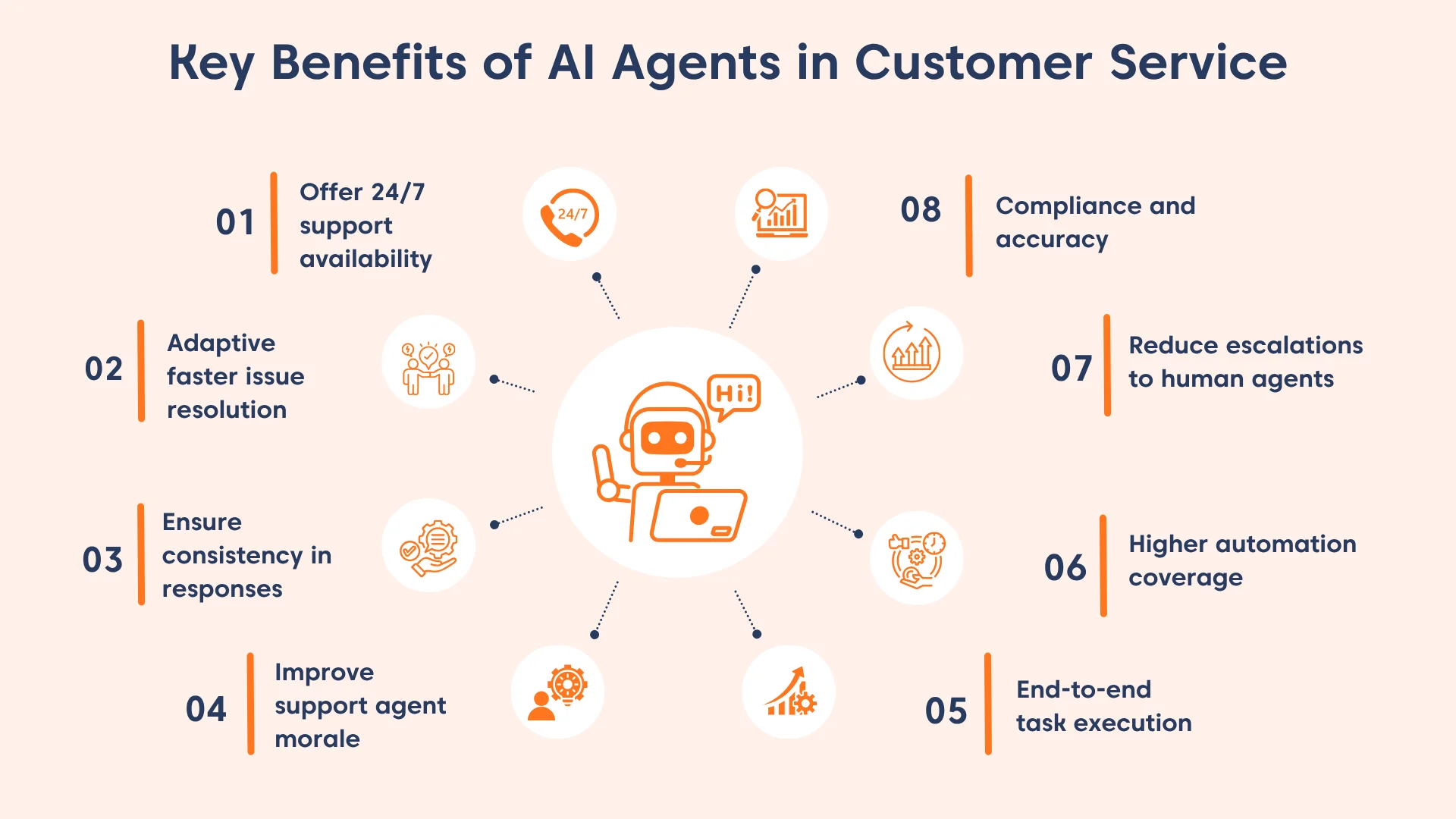
- Offer 24/7 support availability: Operate around the clock with zero downtime to ensure customers get instant support anytime, regardless of time zone or business hours.
- Faster issue resolution: AI agents can significantly reduce resolution times by understanding intent, maintaining context, and automating routine workflows, helping lower escalations to human agents and improve overall support efficiency.
- Ensure consistency in responses: Deliver uniform, high-quality answers so every customer receives the same level of service.
- End-to-end task execution: The AI agent can call external APIs to perform tasks like canceling orders, checking account balances, or scheduling appointments without human input.
- Higher customer service automation coverage: These virtual assistant agents can automate most routine inquiries with minimal human involvement, allowing support agents to focus on complex issues that need human empathy and problem-solving.
- Reduce escalations to human agents: AI virtual assistants autonomously manage common queries, reducing escalations to human agents.
- Improve support agent productivity and morale: Agents are less burdened with repetitive tasks, which helps reduce customer service burnout and turnover, and boosts overall team morale.
- More reliable and compliant handling of customer data: Automated handling of sensitive information minimizes human error, helping maintain regulatory compliance and data integrity.
How are artificial intelligence agents used in customer service?
AI agents can handle anything from simple tasks to complex workflows, depending on how they’re built and what tools or resources they can access.
Many work together in a system called an agentic system, where each agent handles a specific task and passes it along to the next.
Let’s explore some common use cases where virtual assistant agents are making a measurable impact.

Real-time issue resolution
Waiting for help is one of the biggest frustrations for customers, and delays often lead to dissatisfaction. AI agents eliminate this pain point by offering immediate, intelligent responses around the clock.
They don’t just answer questions or track orders; they actively solve issues without needing human assistance in the following ways:
- Instantly understand customer queries: AI agents use natural language processing to detect the issue and urgency
- Access live customer data: These intelligent systems have direct access to information from CRM and AI help desk tools, enabling them to provide accurate, personalized responses.
- Automatically resolve common issues: AI customer service agents can autonomously resolve issues like password resets, billing inquiries, and order tracking without human intervention
- Continuously learn from interactions: Every customer communication is a learning opportunity for AI agents, enabling them to adapt and improve speed, accuracy, and handling of future real-time issues.
For example, when a customer requests to cancel a subscription, the AI-powered support agents instantly check the account status, calculate a partial refund, and complete the cancellation; all within the same chat.
This kind of real-time resolution eliminates delays and ensures the customer’s issue is handled quickly and efficiently, without human involvement.

Personalizing every customer interaction
Customers value support that feels tailored to their needs, and AI agents make this possible by delivering intelligent, context-aware experiences across every touchpoint.
They don’t just respond; they personalize every step of the journey in the following ways:
- Remember past interactions: These intelligent systems learn from previous conversations and customer behavior to offer more relevant and personalized support.
- Build detailed customer profiles: By analyzing purchase history, preferences, and demographics, they create rich profiles that enable proactive and targeted assistance.
- Anticipate customer needs: Using predictive analytics, virtual assistant agents can adjust their tone, suggest helpful actions, and even solve problems before the customer asks.
- Maintain context across channels: Whether it’s chat, email, or phone, AI-powered support agents ensure a consistent and personalized experience throughout the customer journey.
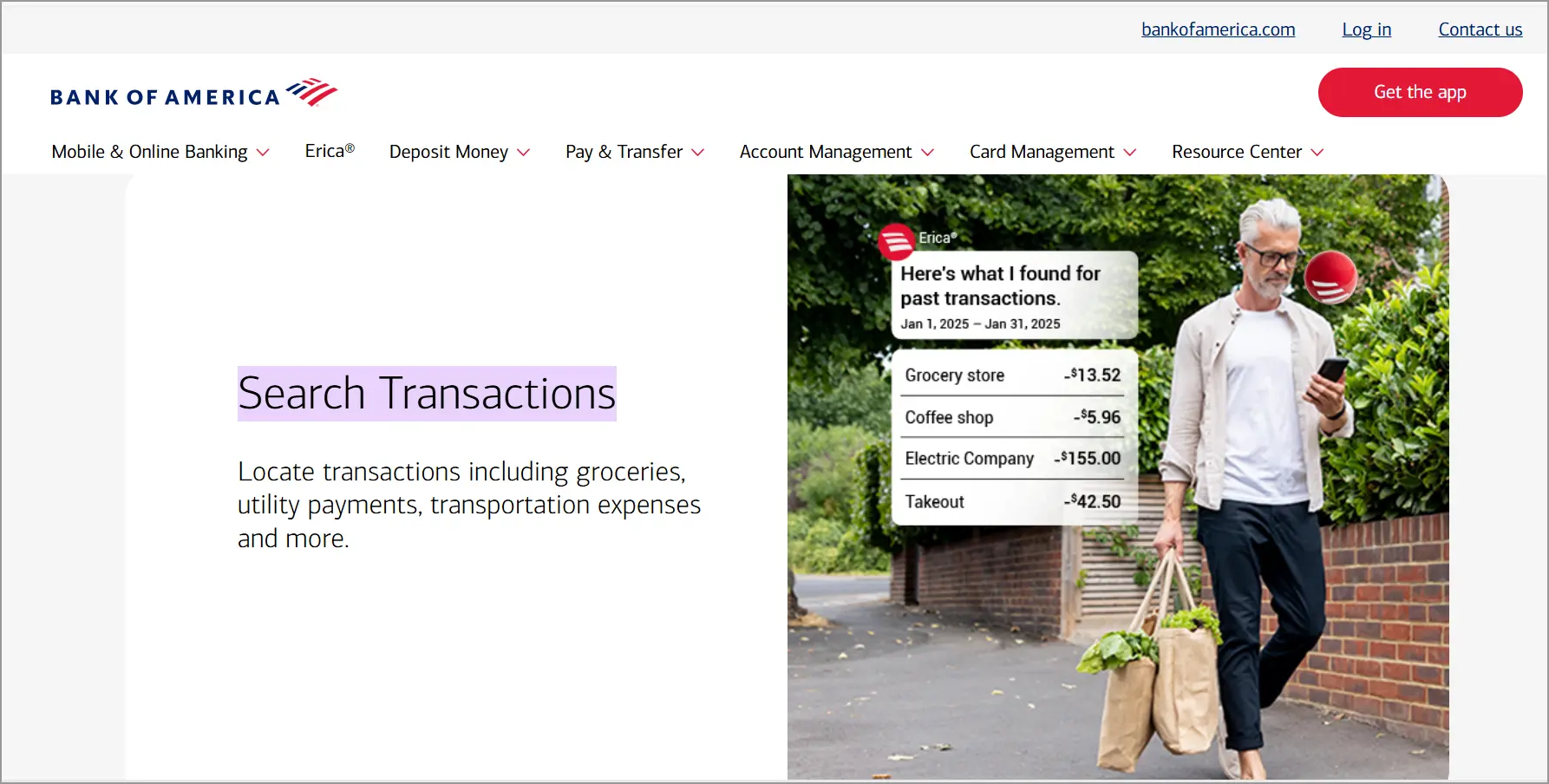
For example, Bank of America’s virtual assistant, Erica, helps users track spending habits, provides tailored banking tips, and sends proactive alerts, making financial management more customer-centric.
Automates repetitive and manual tasks
Handling support tickets manually can be time-consuming and prone to delays. AI agents simplify this by automatically reviewing incoming customer queries, identifying the issue type, and routing them to the correct department or team.
With customer service automation becoming central to modern support, AI virtual assistants are set to resolve 80% of customer service issues by 2029, eliminating manual sorting and speeding up resolutions (Gartner).
By taking over repetitive tasks like tagging, categorizing, and prioritizing tickets, these intelligent systems free up human agents to focus on complex cases, boosting both efficiency and customer satisfaction.
Providing smooth multilingual support
AI agents deliver seamless, real-time support across multiple languages by automatically detecting a customer’s preferred language and adapting mid-conversation.
Agentic AI in customer service can:
- Maintain consistent brand tone across languages
- Access localized knowledge bases with region-specific policies
- Offer both voice and text support simultaneously
When complex issues arise, customers are either guided through real-time translation or intelligently routed to multilingual specialists for further assistance.
This multilingual customer support enables businesses to serve a global audience without requiring separate teams for each language.
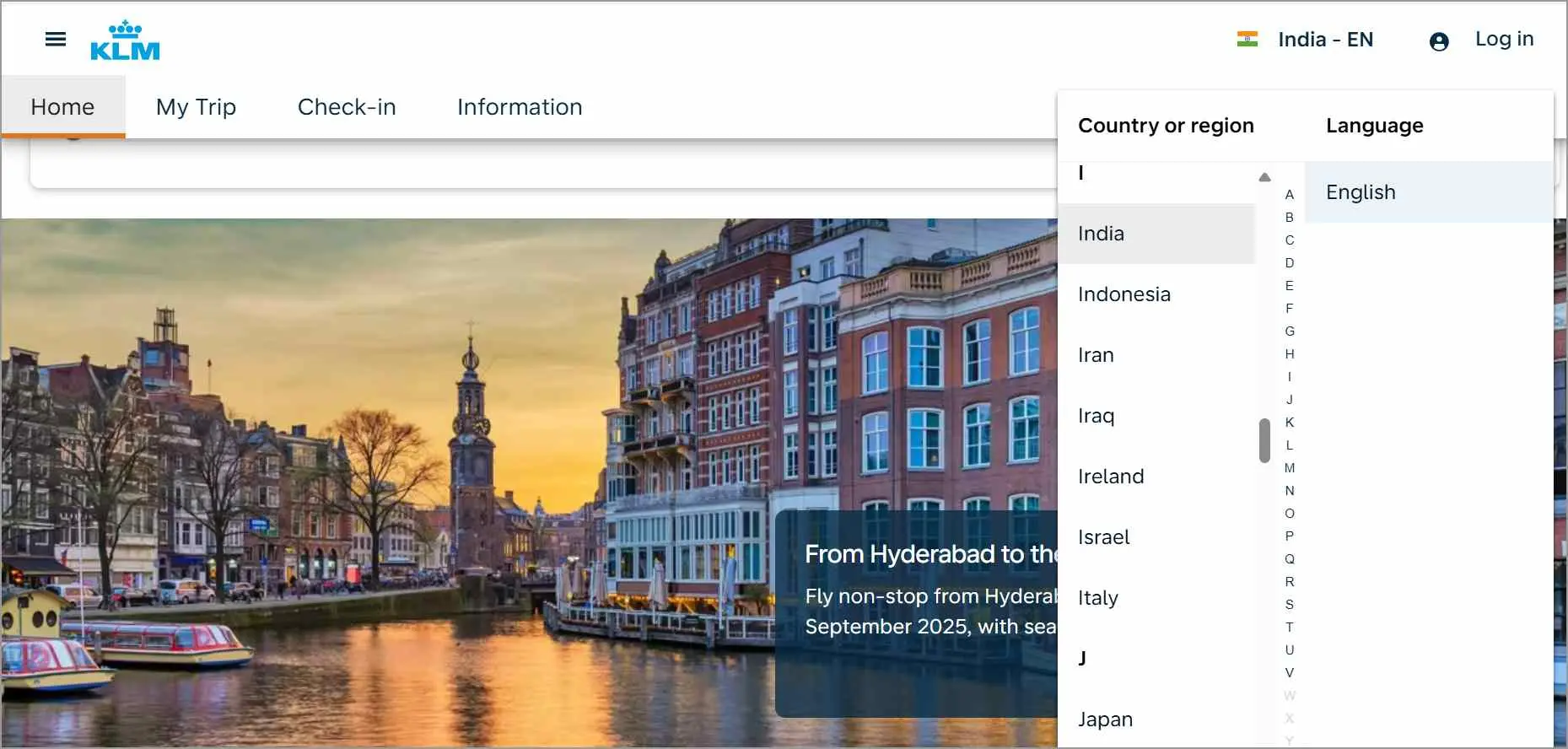
For example, KLM Royal Dutch Airlines’ AI-powered platform helps customers book flights, check flight status, and receive travel advice in their native language, enhancing global engagement.
Connecting support teams to the tools they use every day
AI agents act as smart bridges between customer service and core business systems like CRM and help desk platforms. They automate the flow of information across these tools, ensuring that support agents always have access to the most current and relevant customer data.
This integration works by:
- Syncing customer records automatically: AI agent tools update customer data across systems in real time, removing the need for manual input and reducing errors.
- Providing instant access to customer history: They pull data like preferences and past interactions to help deliver faster, more personalized responses.
- Feeding service data into analytics tools: This allows businesses to track performance, spot trends, and make smarter decisions based on real-time insights.
- Automating routine support tasks: From ticket assignment to follow-ups and data entry, the virtual assistant agents handle repetitive work so human teams can focus on complex issues.
By connecting intelligent systems and streamlining workflows, AI agents help transform customer service into a proactive, data‑driven function that supports both customer satisfaction and business growth.
Sentiment detection and feedback analysis
Advanced virtual assistant agents are designed to understand customer emotions in real time, changing how businesses manage feedback and improve service.
By examining tone, word choice, and interaction history, these systems go beyond surface-level understanding to deliver truly empathetic customer service.
These intelligent agents can:
- Match response tone to customer emotions
- Generates sentiment reports to help teams improve their approach
- Automatically flag and escalate emotional conversations to live agents when needed
Unlike traditional systems that rely on post-chat surveys, AI agents provide live emotional insight, helping businesses stay proactive, responsive, and customer-focused.
AI agents vs. Chatbots: What’s the real difference?
Not all AI‑powered customer service tools work the same way. Traditional chatbots rely on scripted responses to handle predictable, basic questions, which limits their effectiveness when conversations go off‑script.
AI agents, by contrast, are designed to handle complex, multi‑step interactions. They can make decisions, retain context, learn from past interactions, and act across connected systems, enabling more intelligent, personalized, and end‑to‑end customer support.
Below, we highlight the key distinction between an AI agent vs chatbot and why they represent a shift in modern customer service.
| Aspects | Traditional chatbots | AI agents |
| Task complexity | Answers basic, scripted questions with limited personalization. | Handles complex, multi-step workflows simultaneously. |
| Contextual awareness | Limited to scripted flows with no context, forcing customers to repeat information. | Retains and applies context from past interactions. |
| Actions | Relies on scripted responses and fails when conversations go off‑script. | Executes tasks independently without human agents’ intervention. |
| Integration | Limited or no integration with other tools or apps. | Deep integration with third‑party business systems. |
| Learning and improvement | Static, hence, requires manual updates.
|
Continuously improve through learning and feedback. |
Use cases of AI agents in different industries
Intelligent systems are being adopted across industries to automate complex workflows, improve operational efficiency, and deliver more personalized user experiences.
Unlike basic automation, these agents can make decisions, retain context, and take action across connected systems.
| Industries | Use cases |
| Customer service | AI agents guide onboarding, resolve common issues end-to-end, surface insights from conversations, and escalate complex cases with full context. |
| E-commerce and SaaS | AI agents manage orders or subscriptions, handle refunds and cancellations, assist with setup or troubleshooting, and update customer accounts, all within a single conversation. |
| Logistics | AI agents monitor shipment status, notify customers of delays, adjust delivery schedules, and reroute orders based on real‑time conditions. |
| Manufacturing | In manufacturing, they track equipment performance, predict maintenance needs, manage inventory levels, and alert teams before disruptions occur. |
| Education | AI agents respond to student inquiries, manage attendance workflows, and support communication between students, parents, and administrators. |
| ITSM (IT service management) | In ITSM, virtual assistant agents classify tickets, diagnose incidents, trigger automated fixes, and escalate issues with full system context. |
| Banking | In banking, AI agents identify potential fraud, assist with account or loan processes, and deliver personalized guidance based on customer behavior. |
| Real estate | These artificial intelligent agents qualify leads, answer listing and financing questions, schedule property viewings, and maintain continuity across buyer interactions. |
| Healthcare | Autonomous agents schedule appointments, provide triage guidance, answer routine questions, and route patients to appropriate departments, freeing clinicians to focus on care. |
What are the challenges of customer service AI agents?
As AI agents become more integrated into business workflows, it’s essential to recognize the complexities and constraints that come with them.
Being aware of these factors helps organizations make informed decisions, refine their implementation strategies, and unlock the full potential of AI-driven support:
- Data privacy and security: Intelligent agents handle sensitive client data, so businesses must enforce strong AI agent guardrails, including access controls, data encryption, audit logs, and human‑in‑the‑loop escalation to ensure secure, compliant data usage.
- Initial setup effort: Setting up these virtual assistant agents takes time, money, and planning. It involves training the system with quality data and integrating it into existing tools.
- Handling complex queries: Intelligent agent systems handle routine queries well but may struggle with ambiguous or emotionally sensitive issues. These should be passed to human agents smoothly.
- Continuous updates: AI agents need regular updates and training to stay accurate and useful as customer needs and products change.
Redefining the future of customer service with AI agents
As customer expectations evolve, businesses must adopt innovative tools to stay competitive and achieve customer service excellence.
From automating routine inquiries to enabling 24/7 availability, streamlining support, improving response times, and delivering personalized experiences at scale, AI agents are becoming the default layer of customer interaction.
With powerful AI customer service software like BoldDesk AI Agent, you can automate routine tasks, reduce support costs, and respond to customers up to 3x faster than traditional chatbots.
Ready to revolutionize your customer support? Contact us to start a 15-day free trial of BoldDesk AI Agent and discover how AI can elevate your customer experience and drive digital transformation.
Do you have any thoughts or questions about AI agents for customer service? Leave a comment in the feedback section and share your insights with us!
Related articles
- Automated Customer Service – The Complete Details
- Chatbot vs Live Chat in 2025: Which is Best?
- Future of Customer Service: Top Trends for Businesses in 2025
Frequently Asked Questions (FAQs)
An AI agent in customer service is an autonomous AI-powered system, designed to interact with customers and take actions to achieve specific goals. It understands customer queries, interprets context, and provides accurate, real-time support.
These agents can perform a wide range of tasks, such as answering frequently asked questions, resolving complex issues, and routing requests to the appropriate departments, often without the need for human intervention.
Virtual assistant agents interact with their operational context to accomplish specific tasks, but the nature and complexity of the information they process depend on the type of agent involved. They include:
- Multi-agent system: Multiple AI tools (Copilot, Agent, Actions) work together to streamline support.
- Learning agent: Improves over time by analyzing ticket history, customer sentiment, and agent feedback.
- Goal-based agent: Navigates customer queries by prioritizing resolution paths that align with defined support goals (e.g., reducing response time).
- Utility-based agent: Optimizes customer support decisions by balancing speed, accuracy, and customer satisfaction to deliver the best possible experience.
AI agents help deliver instant, consistent responses and operate 24/7, which significantly reduces wait times. They help businesses scale efficiently by automating routine tasks and personalizing interactions using customer data.
AI agents free up human staff to focus on more complex or sensitive issues, leading to faster resolutions, increased productivity, and a more satisfying customer experience.
A seamless handoff happens when AI agents recognize that the issue is more complicated. With smart routing and context-aware transitions, they escalate complex queries to human agents without losing conversation history, ensuring continuity and a smooth customer experience.
AI agents can handle a wide range of tasks from basic to complex. The most common include:
- Answering FAQs (e.g., order status, account info)
- Processing refunds or returns
- Scheduling appointments
- Updating customer records
- Detecting sentiment and adjusting tone