


TL;DR: A 360 customer view unifies data from every touchpoint, helping businesses personalize experiences, improve decision-making, and strengthen customer relationships. With accurate, connected insights, teams can anticipate needs, resolve issues faster, and drive sustainable, long-term growth.
In today’s world, customers expect more than just fast service; they want personalized service that makes them feel understood and valued.
When customer data is scattered across systems, teams struggle to personalize interactions, resolve issues quickly, and understand the full customer journey.
A 360 customer view solves this by unifying data from email, chat, phone, and other touchpoints into a single, continuously updated customer profile.
With this holistic view, you can understand customer behavior and preferences, personalize every interaction, and make smarter decisions that drive loyalty and growth.
In this blog, we’ll break down what a 360-degree customer view is, explore its key components, and show how businesses use it to deliver smarter, more connected service.
What is a 360 customer view?
A 360-degree customer view, also known as a “360 customer view,” is a unified profile that consolidates all customer data into a single, connected record.
It includes identity details, purchases, support history, behavior patterns, marketing interactions, and other key data.
By eliminating data silos, a360 customer view gives teams a complete understanding of customer needs and enables more personalized, consistent, and satisfying experiences.
How a 360 customer view works
A 360 customer view works by collecting customer data from every interaction, unifying it into a single profile, and activating that insight across teams in real time. This includes:
- Collecting data: Customer data is gathered from all touchpoints, including website activity, purchases, support interactions, marketing engagement, product usage, and feedback.
- Unifying data: All collected data is sent to a central platform, such as a CDP or CRM, where it is standardized and consolidated into one system.
- Resolving identity: Customer identifiers like email addresses, account IDs, or device data are matched to ensure each customer has one accurate, unified profile.
- Updating profiles in real time: The unified customer profile updates automatically as new interactions occur, keeping customer information current and reliable.
- Activating insights across teams: The complete customer profile is used by support, marketing, and sales teams to personalize interactions, resolve issues faster, and recommend relevant solutions.
What are the key components of a 360-degree customer view?
A complete customer profile is built by connecting data from every touchpoint, from a customer’s first contact to their most recent purchase, inquiry, or support request.
Each data element adds value to the overall customer profile, helping to build deeper relationships.
Here are the core components to focus on:
| Data | Key elements | Business value |
| Basic demographics & contact | Name, age, location, contact details | Establishes identity foundation and enables accurate routing and personalization. |
| Purchase and billing data | Orders, renewals, plan tier, invoices, and refunds | Reveals buying habits, loyalty trends, and upgrade opportunities. |
| Support interactions | Tickets, chats, call notes, SLAs, CSAT, and resolution history | Speeds resolution and improves consistency across agents and channels. |
| Digital behavior | Website or app activity, feature clicks, and time on page | Signals intent, friction points, adoption risks, and engagement patterns. |
| Marketing engagement | Email opens, ad clicks, and webinar signups | Improves segmentation and message relevance. |
| Product usage | Login frequency, feature adoption, subscription status | Highlights adoption health and churn risk. |
| Loyalty program activity | Points earned, tier, rewards redeemed | Supports retention tactics and VIP experiences. |
| Events and community participation | Webinars attended, workshops, forum posts, and community engagement | Indicates interest depth and education needs. |
| Referral information | Referral links and ambassador activity | Identifies promoters and organic growth. |
By systematically collecting and integrating these key elements, teams can move from scattered data points to a cohesive and actionable customer profile.
Why businesses are investing in unified customer data
Leveraging customer journey data from various sources helps businesses grow more efficiently in several keyways.
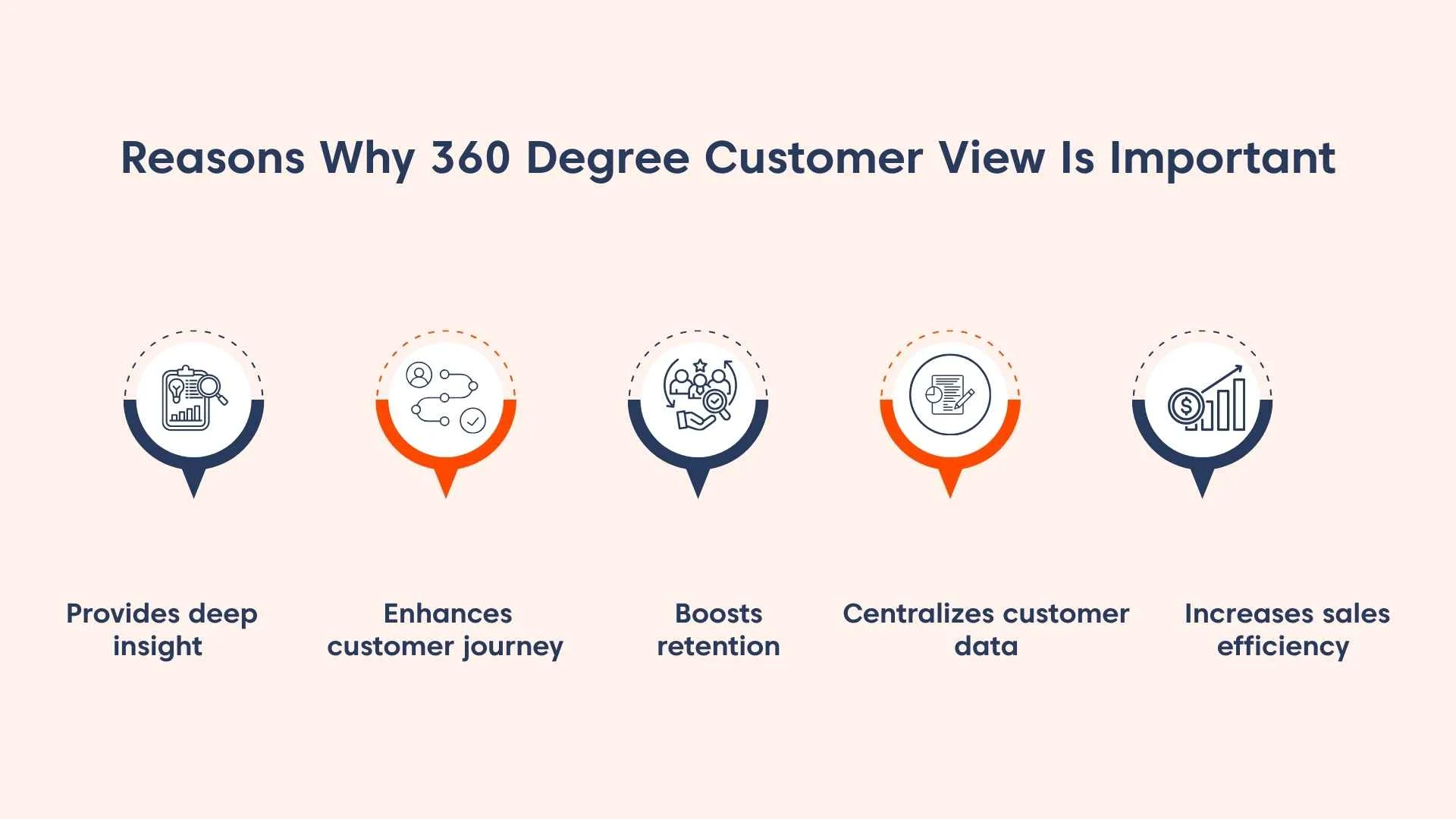
Provides deep insight for informed decisions
Each customer interaction generates valuable data that can be combined into a holistic 360-degree view, offering insights that support informed decision-making.
By analyzing data across multiple interactions, support teams can identify emerging customer needs early.
Real-life example:
Netflix uses a 360-degree customer view to deliver highly accurate recommendations. By tracking behaviors, such as watches, skips, and rewatches, the platform gains deep insight into individual viewer preferences.
This data helps shape informed content strategies that enhance each user’s experience.
It also highlights potential issues that may affect groups of customers and uncovers untapped market opportunities, guiding smarter content planning and product development.
Enhances the customer journey through personalization
A complete customer 360 view gives agents instant access to relevant customer context, enabling personalized interactions at every touchpoint.
According to a study by Forrester, 82% of global B2B marketing decision-makers say buyers expect personalized experiences, and 75% believe customers expect immediate responses to their questions.
Real-life example:
Spotify reviews listening habits, skips, and repeat plays to personalize playlists like Discover Weekly and Wrapped.
This unified customer profile insight helps create meaningful, individualized experiences that deepen loyalty and long‑term engagement.
Boosts retention through proactive engagement
A 360-degree customer view helps companies understand the full picture of each customer’s behavior.
Unified data helps teams identify early indicators of customer churn, such as:
- Reduced product usage
- Increased support requests
- Changing purchase patterns
- Negative feedback
A study by Bain & Company found that a 5% increase in customer retention can boost profits by 25% to 95%.
By identifying at‑risk customers early and addressing their needs before issues escalate, companies can strengthen retention, improve customer satisfaction, and build long‑lasting, loyal relationships.
Centralizes customer information across teams
A single customer profile ensures that marketing, sales, support, and product teams all work from the same information.
This eliminates repeated questions, improves handoffs, and creates a smooth, consistent customer experience.
Increases marketing and sales efficiency
Understanding common customer pain points and frequently asked features allows marketing teams to craft messages that address concerns early.
A Microsoft survey found that companies using customer behavior insights achieve 85% higher sales growth than competitors.
It also helps sales teams recommend products that closely match customer needs.
Real-life example:
Amazon leverages unified customer insights, such as searches, browsing behavior, and cart abandonment, to deliver highly personalized product recommendations and targeted promotions.
This approach boosts conversions, strengthens purchase intent, and improves marketing and sales performance.
How to create a 360-degree customer view for your business
Creating a 360‑degree customer view requires a structured method for unifying insights across your team.
The following steps will help you build a comprehensive customer profile and evaluate whether your existing approach meets essential standards.
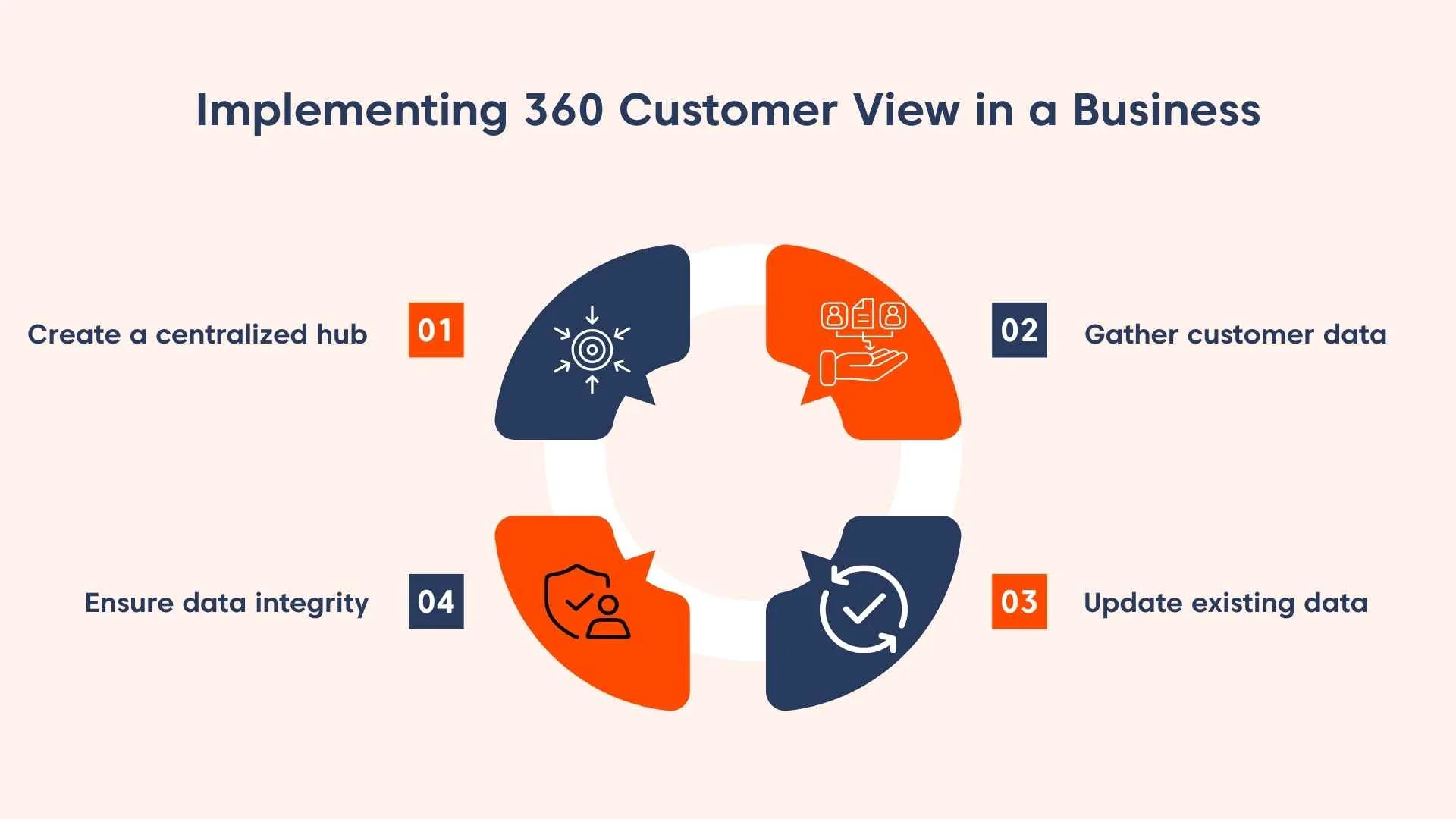
1. Create a centralized hub for customer data
Without a central system, information becomes scattered across departments, making it difficult to understand the full customer journey.
According to Gartner, 78% of organizations centralize data as part of their customer data strategy.
Consider the following data options:
- Customer Data Platforms (CDPs): Builds a consolidated view from multiple sources with strong identity‑resolution.
- Customer Relationship Management (CRM) systems: Manages customer interactions with growing data‑integration features.
- Data Management Platforms (DMPs): Handles anonymous data and audience segmentation.
- Enterprise Data Warehouses: Supports large-scale data storage and advanced analytics for complex data needs.
Choosing the right platform creates a single source of truth, allowing marketing, sales, and support teams to work with consistent, reliable customer information.
2. Identify and gather all customer data sources
Once your customer data collection system is in place, identify customer touchpoints across departments to build a complete 360‑degree customer view.
How to identify data sources
- List customer touchpoints across marketing, sales, support, product, and other teams.
- Review how each system captures data, such as CRM entries, support tickets, website analytics, and email conversation history.
- Confirm what information is stored, who owns it, and how often it’s updated.
How to gather the data
- Pull data from each system into your central platform.
- Standardize formats so customer information aligns across sources.
- Ensure key details, such as contact info, interactions, and behavior signals, are collected consistently.
This approach captures the full customer journey and ensures teams work with accurate, unified data.
3. Update existing customer data
Your existing customer data is just the beginning. It may be incomplete or outdated.
To build a truly accurate 360-degree view of the customer, you need to update and enhance this data regularly.
Here are some effective ways to do that:
Use social media analysis
- Track brand-related comments, mentions, hashtags, and sentiment in real time.
- Combine these insights into a single dashboard for efficient customer data management.
Add external data sources
- Enrich profiles with market research, industry reports, and public datasets.
- Use this broader context to improve segmentation and strategic planning.
Gather direct customer feedback
- Collect feedback through surveys, interviews, and in‑product feedback tools.
- Use this input to understand why customers behave the way they do.
Apply behavioral analytics
- Monitor how customers use your website or app.
- Use tools like heatmaps and session recordings to uncover preferences and pain points.
4. Ensure data integrity and refine the customer view
A reliable 360-degree customer view depends on accurate, high-quality data. To keep customer records consistent, focus on the following areas:
- Data cleansing: Regularly review and update inaccurate or incomplete records. Use automated checks to catch errors early and keep profiles reliable.
- Standardization: Apply clear, consistent rules for entering names, addresses, phone numbers, and other key details, so data remains easy to use across systems.
- Deduplication and identity resolution: Detect and merge duplicate customer records and connect identifiers, such as email, phone numbers, or IDs to create a single, complete customer profile.
Continuously review and refine customer profiling to ensure your 360-degree view stays accurate, relevant, and effective over time.
| What to check | What to do |
| Speed of profile updates | Confirm that new customer data appears promptly. |
| Recent activity reflected in profile | Ensure profiles show the latest customer interactions accurately. |
| Smooth system operation | Monitor delays, slow responses, or synchronization issues. |
| Accuracy of behavioral tags or segments | Verify that segments and tags match the actual behavior. |
| Team usability | Ask internal users about profile usefulness and gather suggestions for improvement. |
This ongoing maintenance ensures your customer insights remain sharp and actionable, empowering teams to support customers and build stronger relationships effectively.
How businesses use a 360-customer view across industries
A 360-customer view brings together customer identity, interactions, and history across tools into one consistent profile.
The goal isn’t just more data; it’s better decisions and better experiences.
Here’s how teams apply a 360 customer view across industries.
Manufacturing: Tailoring product to meet customer expectations
Manufacturers connect product usage data, service tickets, warranty data, returns, and customer feedback to gain visibility into real-world product performance.
With a 360 customer view, teams can spot recurring issues earlier, improve product quality, reduce churn risk, and make more informed product roadmap decisions.
Travel and hospitality: Personalizing end-to-end guest experiences
Brands in the travel and hospitality industry unify booking history, loyalty status, preferences, support interactions, and customer engagement data to personalize the customer journey.
Customers receive more relevant communication, experience fewer service disruptions, and are more likely to return, rebook, or upgrade.
Retail and eCommerce: Driving conversions and customer loyalty
Retail and eCommerce teams combine browsing behavior, purchase history, returns, support conversations, and email or SMS engagement to tailor shopping experiences.
This approach improves conversion rates, strengthens retention, reduces returns, and builds long-term customer loyalty.
Financial services: Delivering context-aware and compliant support
Financial institutions bring together account data, transactions, service history, digital behavior, and customer preferences while meeting compliance requirements.
Sales and service teams can offer more relevant guidance, improve retention, and maintain stronger governance through controlled data access.
Healthcare: Improving care coordination and patient experience
Healthcare and health technology organizations unify appointment data, communications, care coordination touchpoints, and patient preferences across systems.
Patients experience fewer repeated questions, better follow-ups, and more consistent care delivery.
What are the challenges in implementing a 360-degree customer view?
While a 360-degree customer view is highly beneficial, building it comes with several obstacles.
Here are the common hurdles and how to overcome them.
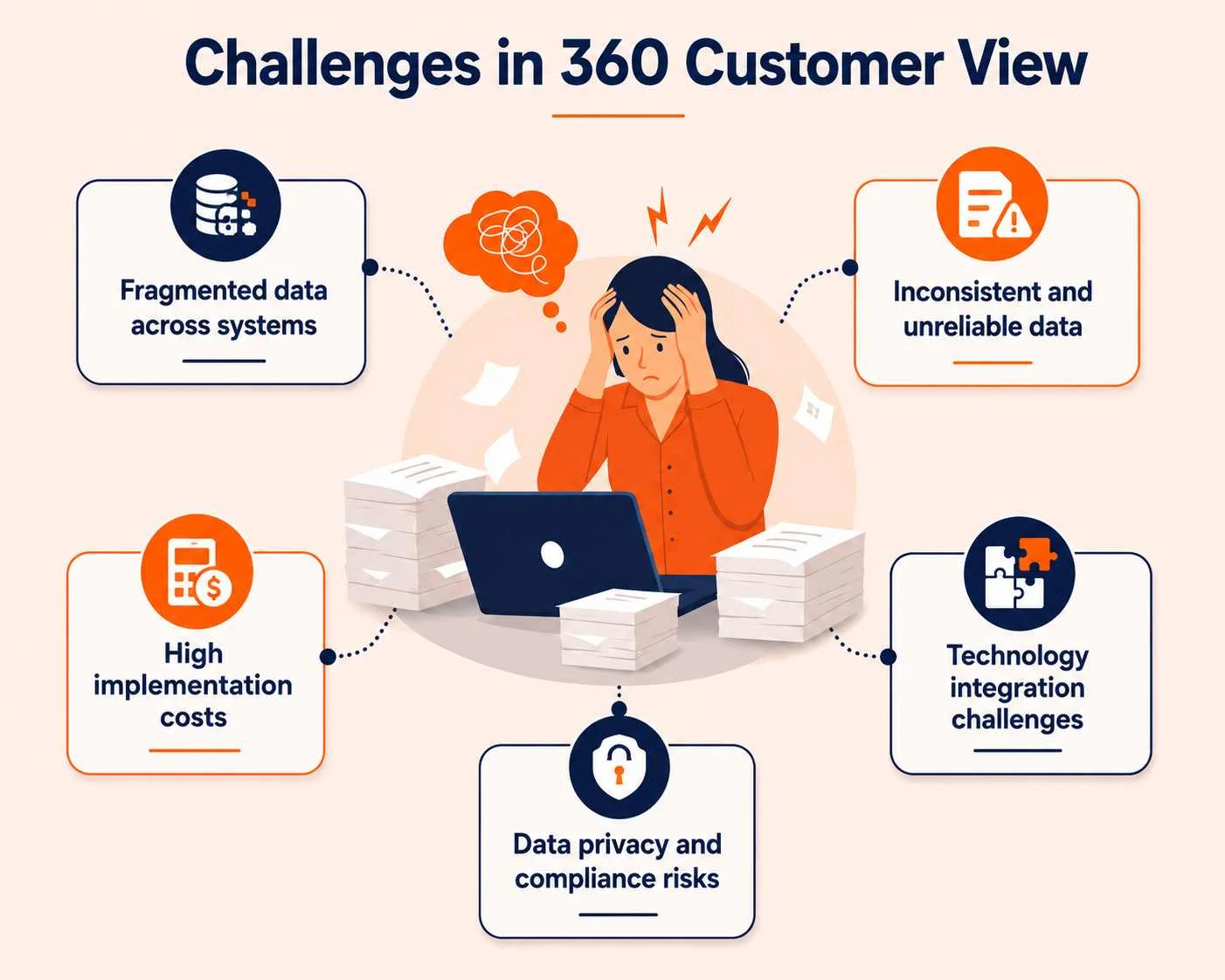
Fragmented data across systems
Customer information is often stored in separate systems across various departments.
These disconnected systems force customers to repeat information and make handoffs slower.
Solution:
- Implement a CDP or CRM to centralize data and integrate systems through APIs or iPaaS tools.
- Set up clear data-sharing processes and encourage cross-team collaboration with shared goals and regular communication.
Inconsistent and unreliable customer data
Customer data is often inaccurate, incomplete, outdated, or formatted inconsistently across systems.
Inaccurate profiles can lead to irrelevant outreach, poor segmentation, or incorrect support decisions
Solution:
- Set up data validation rules at all data entry points.
- Standardize data formats across systems.
- Schedule automated data‑cleansing processes.
- Assign data stewards to monitor accuracy and maintain quality standards.
Complex technology integration challenges
Connecting systems such as CRM, ERP, marketing automation, and e-commerce platforms can be complex. Poor connectivity leads to delayed updates, data gaps, and fragmented customer profiles.
Solution:
- Use APIs or iPaaS platforms to connect systems reliably.
- Prioritize integrating core customer‑facing systems first.
- Monitor data synchronization to ensure information flows smoothly between platforms.
High implementation costs and resource demands
Implementing new technology, training staff, and dedicating personnel to manage and analyze customer data require significant investment.
Solution:
- Start with essential integrations and scale gradually using flexible cloud solutions.
- Train existing staff instead of hiring new personnel.
- Test platforms through free trials before committing.
Track ROI by measuring improvements in customer retention and conversion rates.
Data privacy and compliance risks
Managing customer data must follow regulations like GDPR, CCPA, and other industry-specific requirements. These rules add complexity to how data is collected, stored, and used.
Solution:
- Design systems using privacy-by-design principles.
- Create data inventories that track what data you collect and why.
- Protect all information with encryption and strict access controls.
- Conduct regular audits to ensure continued compliance.
Elevate your customer experience with a 360-customer view
Gaining a complete view of your customers is essential for delivering meaningful experiences.
For support teams, this means less context switching, faster resolutions, and more personalized customer interactions.
Solutions like BoldDesk help support teams centralize customer conversations, capture every request as a ticket, and access customer context through CRM integrations with tools like HubSpot, Pipedrive, and Salesforce.
This gives agents the visibility they need to deliver more consistent customer experiences and gain a significant competitive advantage.
Contact us to unlock the potential of your customer data and drive better outcomes across your business.
How do you think a holistic customer view could accelerate your business’s growth? Share your thoughts in the comments section!
Related articles
- 9 Effective Customer Experience Optimization Strategies
- What is Customer Stickiness? How to Measure and Improve It
Frequently Asked Questions
To create a 360-degree customer view, you need a centralized system, such as a CDP, CRM, or data warehouse, that unifies customer information from all channels and touchpoints.
These systems combine identity details, purchase data, support interactions, marketing activity, and behavior patterns into a single, continuously updated profile.
You can achieve a 360-degree customer view by connecting all customer data sources and consolidating them into one unified profile.
This requires syncing CRM records, marketing engagement data, support history, product usage analytics, and ecommerce activity so teams work from the same real-time information.
A 360-degree customer view draws from multiple data sources, including demographics, transaction history, communication records, support interactions, website or app behavior, marketing engagement, and product usage.
Additional sources often include loyalty activity, event participation, and referral information, creating a complete and actionable customer profile.