

 In this page

TL;DR: An auto-reply email instantly confirms a request, sets expected response times, and reduces follow ups, especially during high volumes, after hours, or staff absences. Most teams automate auto-reply emails using help desk tools with templates, triggers, and placeholders for consistent, scalable support.
Missed emails and delayed responses can frustrate customers, especially when your team is out of office, after hours, or handling a high volume of requests.
An auto-reply email instantly confirms that a message is received and sets expectations for when you’ll respond.
Whether you’re supporting customers, managing a shared inbox, or stepping away from work, auto-replies reduce follow-ups and maintain trust when agents aren’t available.
In this guide, you’ll learn best practices and get ready-to-use auto-reply email templates to deliver a more consistent support experience.
What is an auto-reply email?
An auto-reply email is an automatic response sent immediately when someone emails you, confirming receipt and letting them know when to expect a reply.
Businesses use auto‑reply emails to manage customer expectations, reduce follow‑ups caused by response delays, and maintain clear communication during off‑hours or agent absences.
Automate Support with Smart Auto-Replies!
Save time and boost efficiency with automated email responses that keep customers informed 24/7.

What to include in your auto-reply email
Auto‑reply emails work best when they are clear, concise, and informative.
The following are some of the key elements an effective auto‑reply email should include, depending on your use case:

- Acknowledgment of receipt: Let customers know their email has been successfully received to eliminate uncertainty.
- Expected response time: Clearly state when they can expect a reply from your team.
- Business hours and availability: Share your support team’s working days and hours so customers understand when responses are handled.
- Links to additional resources: Provide access to help articles, FAQs, or documentation that may resolve common questions.
- Alternative contact options for urgent issues: Direct users to emergency support channels or escalation contacts during off‑hours, if applicable.
- Brief reason for unavailability: If the auto‑reply is from an individual, include a high‑level explanation, such as being out of the office without unnecessary personal details.
How to write effective auto-reply emails
The way you express yourself in an auto-reply email reflects how your business communicates with customers and plays a key role in building trust, clarity, and a consistent brand image.
Here are the best practices for writing effective auto‑reply emails:
- Use a clear subject line: Clearly indicate that the email is an automatic response or that you’re currently unavailable, so recipients immediately understand what to expect.
- Start with a polite greeting: Open with a courteous greeting to create a positive first impression and set a respectful tone.
- Thank the sender: Acknowledge their message to reassure them that their email has been received.
- Maintain a professional tone: Ensure the language aligns with your brand voice and reflects professionalism.
- Keep the message brief and direct: Use simple, concise language so the message is easy to read and understand quickly.
- Set clear expectations: Let recipients know when they can expect a response or what the next steps are.
- Sign off professionally: End with your name, role, or support team name for clarity and credibility.
- Proofread before sending: Check for spelling, grammar, or formatting errors to avoid confusion or unprofessional impressions.
When should you use auto‑reply emails in customer service?
Auto‑reply emails are most effective when customers need immediate acknowledgment, even if a detailed response cannot be delivered right away.
You should use auto‑reply emails in the following situations:
- When your team is out of office: Use auto‑reply emails during vacations, holidays, sick leave, or planned absences to inform customers that support is temporarily unavailable and explain when responses will resume.
- Outside business hours: If your support team operates within specific working hours, auto‑reply emails confirm message receipt after hours and set expectations for response timelines.
- During high support volume or surges: When ticket volumes spike due to outages, launches, or peak seasons, auto‑reply emails help acknowledge inquiries and communicate possible delays upfront.
- For shared inboxes or support queues: Auto‑reply emails reassure customers that their request has been received and logged, even before an agent reviews or assigns the ticket.
- For ticket status updates: Automated replies can notify customers that their issue is under review, assigned to an agent, or awaiting further action without requiring manual follow‑ups.
- To redirect customers to self‑service resources: Auto‑reply emails can include links to FAQs, help articles, or documentation to help customers resolve common issues quickly.
- During system maintenance or known issues: Auto‑reply emails proactively inform customers about ongoing maintenance or outages, reducing repeated inquiries and frustration.
Auto-reply email templates for common support scenarios
Sending an acknowledgment message reassures customers that their request has been received and is being addressed.
Acknowledgment auto-reply email template
Sending an acknowledgment message reassures customers that their request has been received and is being addressed.
Example:
Subject: We’ve received your request.
Hi,
Thank you for reaching out to [Company Name]. We’ve received your email and created a support ticket.
A member of our support team will get back to you within 24 hours.
If you have additional details to share, feel free to reply to this email.
Best regards,
[Company Name] Support Team
Status update auto-reply email template
Status update auto‑reply emails reassure customers that their issue is still being handled and provide visibility into the support process.
Example:
Subject: Update on your support request
Hi,
Your support ticket has been assigned to a team member and is currently under review.
If you have new information to add, please log in to the customer portal and update your ticket.
For urgent matters, contact us at [Email] or [Phone Number].
Best regards,
[Name]
Vacation or out of office auto-reply email template
You can be away from your office for various situations, such as vacation, sick, maternity, annual or casual leave.
This template informs senders of the absence, shares when the agent will return, and points them to an alternative contact if assistance is needed sooner.
Example:
Subject: I’m currently out of the office
Hi,
I’m out of the office from [Date Range].
If you need assistance during this time, please contact [Email Address], and a team member will assist you.
For urgent issues, reach out to [Emergency Contact].
Best regards,
[Name]
Delayed response auto-reply email template
A delayed response auto‑reply is useful when your team is available, but response times may be slower due to high ticket volume, system maintenance, or temporary disruptions.
This message manages expectations upfront, explains the delay at a high level, and helps maintain trust during periods of reduced responsiveness.
Example:
Subject: We’re experiencing delays; thanks for your patience
Hi,
We’re currently experiencing a high volume of requests or performing system updates, which may cause response delays.
We appreciate your patience and will get back to you as soon as possible. If your issue is urgent, contact us at [Email] or start a live chat.
Best regards,
[Name]
After-hours auto-responder email template
Smaller companies often cannot offer 24-hour support. The following is a template letting customers know the timeframe for a response and offering methods for finding quicker solutions.
Example:
Subject: We’ll get back to you during business hours
Hi,
Thank you for your message. Our support team is currently unavailable.
We respond during business hours: Monday–Friday, 9:00 a.m.–5:00 p.m. (PST).
In the meantime, visit our knowledge base for FAQs and troubleshooting guides.
Best regards,
[Name]
Feedback auto-reply email template
You can use a customer feedback auto‑reply email to acknowledge customer input and invite them to share their experience.
This helps teams gather insights, improve support quality, and show customers that their feedback is valued.
Example:
Subject: Share your feedback with us
Hi,
Thank you for working with us.
We’d love your feedback to help improve our service. Please share your thoughts using the link below:
[Feedback Link]
Best regards,
[Name]
How BoldDesk helps teams automate auto-reply emails at scale
Managing auto-reply emails manually or with basic email tools can quickly become inconsistent, especially as support volume grows.
Platforms like BoldDesk enable teams to automate and standardize auto-reply communication so every customer receives a timely, relevant response without added effort.
As a result, teams can instantly acknowledge incoming requests, keep customers informed as tickets progress, and maintain clear expectations across every customer interaction.
This reduces follow-ups, improves response time perception, and ensures a more consistent support experience.
BoldDesk’s key capabilities
- Instant acknowledgment at scale: Automatically send confirmation emails as soon as a ticket is created, so customers know their request has been received.
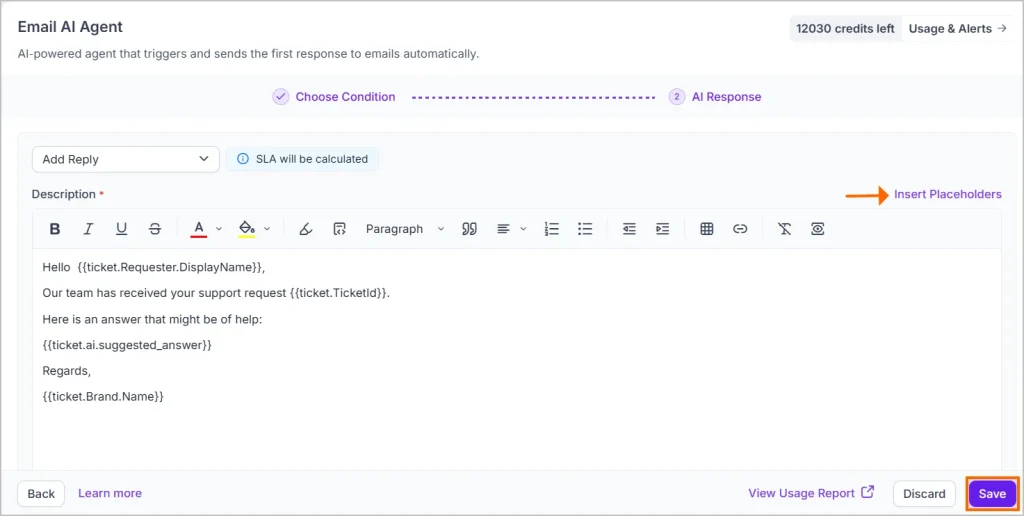
- Trigger-based automation: Send auto-reply emails based on events such as ticket creation, status updates, assignment changes, SLA conditions, or after-hours submissions.
- Dynamic personalization: Use placeholders like ticket ID, requester name, priority, and status to deliver context-aware responses without manual input.
- Scenario-based messaging: Customize replies for different use cases, such as high-priority tickets, VIP customers, or specific categories.
- Consistent communication across the lifecycle: Keep customers updated at every stage, from acknowledgment to resolution, without agents needing to send manual updates.
- Reduced manual workload: Automate repetitive responses so agents can focus on resolving complex issues rather than managing inbox communication.
How to set up an auto-reply email
Setting up an auto‑reply email ensures incoming messages are acknowledged immediately, even when no one is available to respond.
Most email platforms and help desk tools offer built‑in options for sending auto‑reply emails.
The section below outlines how to set up auto‑replies in Microsoft Outlook and Gmail, respectively.
How to set up auto‑replies in Microsoft Outlook
Microsoft Outlook includes a built‑in automatic replies feature that allows you to send an immediate response to incoming emails when you’re unavailable.
Here are the step‑by‑step instructions based on how you access Outlook. If you use Outlook on the web or mobile, the setup is similar, but menu names and navigation may vary slightly.
- Open Microsoft Outlook and select the mailbox you want to configure.
- Click File in the top‑left corner.
- Select Automatic Replies (Out of Office).
- Choose Send automatic replies.
- (Optional) Enable a start and end time so the auto‑reply turns on and off automatically.
- Enter your message in:
- Inside My Organization for internal recipients
- Outside My Organization for external senders
- Adjust external reply settings if you want replies sent only to contacts or to all senders.
- Click OK to save your settings.
How to set up an auto-reply in Gmail
Gmail includes a built‑in Vacation Responder that allows you to send automatic replies when you’re unavailable.
This option is best suited for out‑of‑office messages and basic acknowledgment emails.
Follow these steps to enable it:
- Open Gmail and click the settings (gear icon).
- Select See all settings.
- Scroll to the Vacation responder section.
- Turn the vacation responder on.
- Set your start and end dates.
- Add your subject line and message.
- Choose whether replies should be sent to contacts only or to all senders.
- Click Save changes.
Note: Gmail’s vacation responder sends one automatic reply per sender and does not support conditional or trigger‑based responses.
This makes it suitable for simple out-of-office replies, but not for customer support workflows that require automation based on ticket status or priority.
For more advanced automation, such as sending different auto‑reply emails based on message content, timing, or ticket status, teams typically rely on email ticketing systems that can support templates, triggers, and rules.
Scale customer support with smarter auto-reply emails
Clear, timely communication is a key driver of customer satisfaction.
When customers know their requests are being handled, support teams spend less time managing follow‑ups and more time resolving issues efficiently.
With BoldDesk, auto‑reply emails become a reliable part of your support operations.
By combining ready‑to‑use auto-reply email templates, dynamic placeholders, and trigger‑based rules, teams can maintain consistent communication throughout the ticket lifecycle while scaling customer support without added effort.
Ready to reduce unnecessary follow‑ups and deliver faster, more consistent support?
Try our 15-day free trial to see how auto‑reply automation fits seamlessly into your support workflow.
For further information, contact our support team, who are always ready to assist you.
Related articles
- Customer Feedback Loop: Importance and How to Close It
- 7 Best Techniques for Reducing Customer Service Response Time
- AI Email Triage: How Support Teams Reduce Inbox Clutter Automatically
Frequently Asked Questions
Not exactly. Out-of-office emails are a specific type of auto-reply used during absences, while auto-reply emails can also be triggered by events such as ticket creation, status updates, or after-hours submissions.
Auto-reply emails should be short and clear, typically 3 to 6 sentences.
The goal is to acknowledge receipt, set expectations, and provide next steps without overwhelming the reader.
Yes. By clearly confirming receipt and setting response expectations, auto-reply emails reduce uncertainty and prevent customers from sending repeated follow-ups to check whether their message was received.
Yes. Auto-reply emails can be sent to both internal and external contacts, but the content should differ.
Internal auto-replies may include operational details, while external replies should remain brief, professional, and focused on setting customer expectations.
Auto-reply emails should be avoided when agents are immediately available or when messages require sensitive, personalized responses that are better handled manually.