


 In this page

TL;DR: “Happy to help” is a common customer service phrase used to show willingness to assist customers. However, because it is widely used, it can sometimes sound scripted or impersonal. Alternatives such as “It’s my pleasure,” “Pleased to assist,” and “We’ve got your back” feel more authentic and strengthen customer relationships.
Customer service teams handle everything from product questions to customer complaints, often all at once. And while familiar phrases like “happy to help” sound polite, they’ve become so overused that they no longer feel genuine or impactful.
Today’s customers want more than courteous words; they expect authentic empathy backed by real effort and meaningful support.
According to Salesforce State of the Connected Customer report, 88% of customers say the experience a company provides is as important as its products or services.
That’s why it’s important to enhance your communication skills. By using more intentional, thoughtful alternatives, you not only keep your conversations warm and engaging but also contribute to a superior customer service experience.
In this blog, we’ll explore professional, more sincere “happy to help” alternatives and how you can use them to create engaging, more personalized customer interactions.
What does “happy to help” mean, and why you should use alternative phrases
“Happy to help” in customer service is an expression used to convey willingness and eagerness to assist a customer. It implies the person is delighted to provide support.
It was originally considered a fantastic substitute for the more general “you’re welcome.” However, it has become so commonly said that it usually sounds robotic.
When customers call, they expect an expert from a 24/7 support team who can solve their problems.
When they realize that you are prepared and dedicated to assisting them, it can ease frustration and build customer trust.
According to McKinsey, 71% of consumers expect personalized interactions from businesses, while 76% become frustrated when those expectations are not met, making thoughtful, context-specific responses more important than ever.
On the other hand, hearing a phrase delivered out of routine rather than authenticity can make your support feel impersonal and less credible.
“Happy to help,” but is your support team happy?
Polite customer service language is important, but it doesn’t always reflect what’s happening behind the scenes.
While customers receive empathy and reassurance, support teams often face pressures that make it hard to genuinely feel “happy” during every interaction. Here’s what contributes to that gap:
- Repetitive emotional labor: Customer service agents must stay calm, positive, and empathetic in every conversation, even when dealing with frustration, confusion, or hostility. Over time, this constant emotional performance becomes exhausting.
- High pressure to solve issues quickly: Every support ticket comes with urgency. Knowing customers expect fast answers can turn even simple conversations into stressful exchanges.
- Rising customer expectations: Thanks to fast digital customer experiences, customers demand perfect solutions, personalized assistance, and zero friction all at once, raising the bar for every interaction.
- Large ticket volumes with limited resources: Teams are often understaffed yet required to resolve more issues across more channels without compromising quality or speed.
- Scripts that feel restrictive: Customer service phrases like “happy to help” are meant to sound friendly, but over-reliance on scripts can make agents feel robotic, disconnected, or unable to express authentic empathy.
- Constant multitasking and context switching: Moving between tickets, tools, and communication channels requires intense focus. Over time, the mental load builds quickly.
When “happy to help” becomes a customer support problem
What may seem like a small language choice can quietly work against broader customer service goals, especially when teams are balancing speed, quality, and consistency at scale.
Here’s how this shows up in real-world support environments:
- Instant response expectations: Today’s customers expect prompt replies. A friendly “happy to help” phrase creates an assumption of instant availability, even when teams are stretched thin or handling complex issues.
- Recurring requests and manual responses: Many customer requests come up daily. Without automation, agents must manually type the same reassuring lines repeatedly. This repetitive work drains energy and leaves little time for higher-value problem-solving.
- High ticket volumes and constant SLA pressure: “Happy to help” usage doesn’t clear ticket queues. Teams still operate under strict response-time targets and growing backlogs. What feels like a polite gesture to customers often represents another clock ticking for agents.
- Agent burnout from round‑the‑clock availability: With global customers and 24/7 expectations, agents are expected to stay upbeat even when mentally fatigued. A cheerful phrase can hide the emotional toll of always being “on.”
Alternatives and synonyms for “happy to help” in customer service
There are several ways to offer assistance and support that can be considered decent alternatives to the phrase “happy to help”.
Outstanding alternatives (+ synonyms) for the “happy to help” phrase
- I’m thrilled I could assist you
- Feel free to reach out to us
- I’m glad we were able to solve your problem today
- It’s my pleasure
- I’m more than willing to pitch in and help
- I’m glad for the opportunity to help you today
- I’m at your service
- You got it
- We’ve got your back!
- We’re always here to support you
- Pleased to assist
Let’s look at these “happy to help” alternatives and synonyms, with their respective examples. Get to know and choose the right customer service expression to help you set a positive tone and show a genuine willingness to help a customer whenever they reach out for assistance.
Get Customer Support Absolutely Free for Startups!
Struggling with customer queries? Handle tickets seamlessly and drive business growth without costs.

1. “I’m thrilled I could assist you”
It’s acceptable to feel proud when you help someone. Thus, after assisting customers in reaching their objectives, you can respond with “I’m thrilled I could assist you.”
It’s a kind and approachable sentence you can use once you’ve assisted a customer in resolving their issue.
Other “happy to help” examples include:
- “Glad to be of assistance”
- “I’m happy I was of help to you”
Here is an example:
Dear [Name],
I’m thrilled I could assist you today. Is there anything else you need from me today?
Best regards,
[Agent Name]
2. “Feel free to reach out to us”
The “happy to help” alternative phrase is an invitation to customers to contact the support team again without any reservation.
Some customers may feel like they’re bothering your support agents when they have questions or problems.
A customer service expression like this indicates your company has a welcoming attitude toward communication.
Other “happy to help” alternatives to this phrase include:
- “Feel free to get in touch with us at any time”
- “Please don’t hesitate to reach out”
The following is an example:
Hello [Name],
If you have any questions or need further assistance, please don’t hesitate to reach out. We’re here to help, and we’re happy to support you.
Best regards,
[Agent Name]
3. “I’m glad we were able to solve your problem today”
This customer service phrase expresses the support team’s satisfaction that an issue or problem has been resolved. It’s a positive acknowledgment of successful assistance.
Other professional “happy to help” alternative phrasing could include:
- “I’m delighted we could assist in resolving your issue today.”
Here’s an example:
Dear [Customer Name],
It gives me great satisfaction to know that my team successfully resolved your issue. If you have any more concerns, you can count on us.
Best regards,
[Agent Name]
4. “It’s my pleasure”
This “happy to help” alternative phrase adds a touch of formality while expressing delight in assisting customers.
Whenever a customer is worried or frustrated about an issue, this is a helpful customer service phrase to use after they ask for help.
It soothes any intense emotions the customer might be experiencing and demonstrates your confidence in your troubleshooting skills.
Similar “happy to help” alternative phrases include:
- “It would be my pleasure.”
- “I’m delighted to help you.”
- “I’m happy to assist you.”
Below is an example:
Dear [Name],
It’s my pleasure to help you with your issue on this project. Let’s get started!
Best regards,
[Agent Name]
5. “I’m more than willing to pitch in and help”
This phrase is good, for instance, when you’re collaborating with your customer to find a solution.
When an issue requires some back-and-forth, you are not stepping in as a know-it-all, but a temporary team member with “happy to help” alternative expertise.
It can lower frustration and perhaps embarrassment a customer may feel at being unable to solve something themselves.
Other phrasings include:
- “I’m interested in lending a hand wherever it’s needed.”
- “I’m here and more than willing to help you.”
Here is an example:
Dear [Name],
I heard about the issues you’ve been having with your [ the situation/project/etc], and I wanted to reach out. I’m more than willing to pitch in and help you. Please let me know a time when we can have a call and go over the process that’s causing you difficulty.
Best regards,
[Agent Name]
6. “I’m glad for the opportunity to help you today”
This phrase expresses a positive sentiment toward being given a chance to provide support.
Other similar phrasings include:
- “I wanted to express my gratitude for the opportunity to assist you today.”
- “I’m grateful I could assist you today.”
- “Glad I could lend a hand today.”
- “I’m thankful for the chance to help.”
The following is a use case example:
Dear [Name],
I’m glad for the opportunity to help you today. If there’s anything else I can do to make things easier for you, please don’t hesitate to let me know.
Best regards,
[Agent Name]
7. “I’m at your service”
Use this expression when customers anticipate a formal interaction, such as at a fine dining establishment or high-end hotel.
However, it is not appropriate for every customer support team.
This helps you as a service representative to stay on board and maintain a professional tone aligned with premium service.
Other “happy to help” alternatives to use include:
- “I’m here to help.”
- “What can I do for you?”
- “I’m here to support you.”
Here is an example:
Dear [Name],
I‘m at your service, dedicated to resolving any issues or answering questions you may have. Feel free to contact me.
Best regards,
[Agent Name]
8. “You got it”
This statement is perfect if you’re searching for a more relaxed attitude, because it gives the customer the confidence to ask for assistance.
In a less formal and tense situation, speaking naturally and with confidence can help build rapport, if it’s backed up by competent service.
If you have established good customer connections and they don’t expect you to be formal, I would also suggest using this statement or a similar one.
Other alternatives include:
- “No problem.”
- “Absolutely. Let’s get started on that.”
Here is a good example:
Dear [Client Name],
As we discussed earlier, everything is under control. You got it! Rest assured, you’ll get a response or solution soon.
Best regards,
[Agent Name]
9. “We’ve got your back!”
This expression shows willingness, reliability, and solidarity to support customers through difficult situations.
Similar customer service expressions to use include:
- “We’ll look out for you.”
- “You’ve got our support.”
Let’s look at an example:
Dear [Customer Name],
Always know that, no matter the challenge, we’ve got your back! Talk to our team about all your support-related issues.
Best regards,
[Agent Name]
10. “We’re always here to support you”
This happy to help alternative phrase shows that you’re not just helping with one specific task but are available for continuous 24/7 customer service.
Below is an example:
Dear [Name],
We’re always here to support you through every step of your journey, any day, any time.
Best regards,
[Agent Name]
11. “Pleased to assist”
A slightly more formal alternative that communicates professionalism. It expresses satisfaction in being able to help the customer.
For example:
Dear [Name],
I’m pleased to assist you with setting up your account.
Please begin by using this email address and the following password to log in.
…
Best regards,
[Agent Name]
Take your customer communication to the next level. Download the complete PDF guide of “happy to help” alternatives to discover more authentic phrases and create stronger customer interactions.
Download “Happy to Help” Alternative Cheat Sheet
How to stop saying “happy to help”
There are many professional alternatives to “happy to help,” but habits can be hard to break.
Varying your phrasing intentionally helps align everyday support conversations with long-term customer service goals, such as building trust, reducing friction, and delivering consistent experiences.
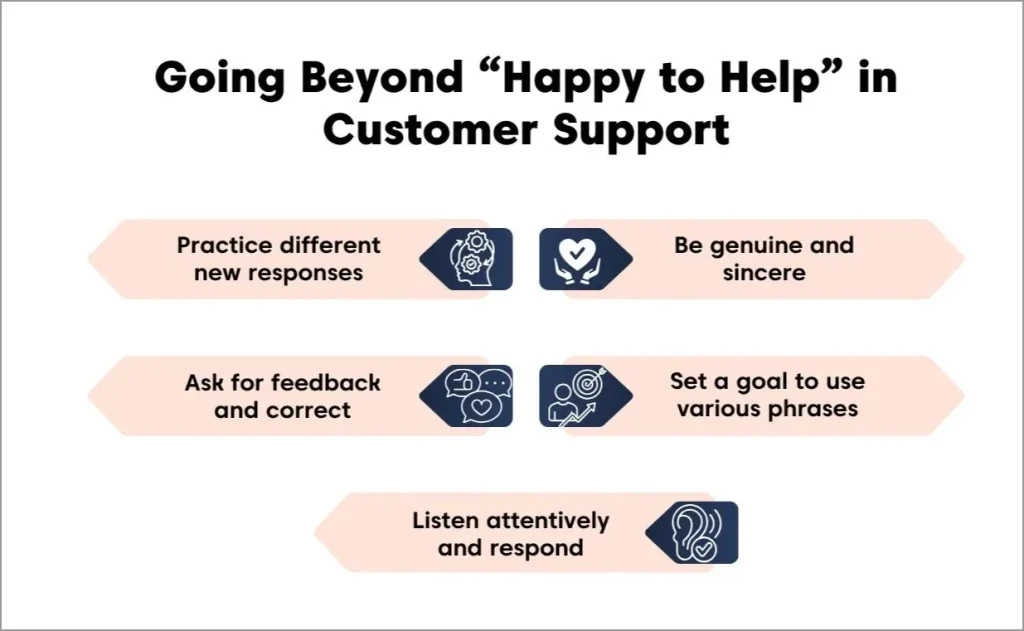
Practice new responses
Keep a short list of alternative phrases you can rotate through in daily interactions. Using different expressions consistently helps them feel natural over time and reduces reliance on default, overused language.
Be genuine and sincere
The goal isn’t to replace one scripted phrase with another. Choose wording that feels honest and aligned with your tone and values. If a phrase feels forced or unnatural even after practice, it’s better to use something simpler that sounds authentic.
Ask for feedback and refine
Teammates, QA reviewers, or managers can help identify moments when responses sound robotic. Ask for suggestions on more natural phrasing and use that feedback to refine how you communicate with customers.
Intentionally vary your phrasing
Challenge yourself to avoid repeating the same response across similar situations. Small variations in language can make interactions feel more personal and attentive, even when handling common requests.
Listen and adapt
Pay attention to how coworkers and even customers phrase reassurance and support. Borrow expressions that resonate with you and adapt them to your own voice to expand your range of natural responses.
Deliver “happy to help” alternatives at scale
Choosing better alternatives to “happy to help” shows genuine intent in every interaction.
The strongest customer service teams standout not because they use perfect phrases, but because they communicate consistently, thoughtfully, and with context- no matter how busy things get.
That’s where tools like BoldDesk come in. By helping teams manage conversations in one place, reuse well-crafted responses, and reduce repetitive typing with AI-assisted drafting, BoldDesk empowers support teams to deliver clear, human communication at scale, without losing the personal touch.
Ready to elevate your customer support? Generate natural, non-scripted customer replies with AI, improve response quality, and resolve issues faster. Schedule a live demo to see how your team can deliver more consistent, authentic customer interactions at scale.
What alternatives to “happy to help” do you use most often? Share your favorites in the comments below.
Related articles
- What Is Customer Advocacy? Definition, Strategies, and More
- What Is Good Customer Service? Tips & Examples | BoldDesk
- Customer Feedback: 7 Strategies for Collecting It | BoldDesk
FAQs
By handling repetitive and simple requests, automation frees agents to focus on complex issues that require empathy and judgment, helping teams stay responsive while keeping customer interactions genuinely human.
With features like ticket automation, live chat, and AI‑assisted replies, teams can consistently provide helpful and timely support without overwhelming agents.
This reduces repetitive work for customer service agents while ensuring replies remain clear, personalized, and customer‑friendly.