

 In this page

TL;DR: When comparing chatbots vs live chat, the right choice depends on your support goals. Chatbots provide instant, 24/7 assistance for routine inquiries, while live chat enables personalized support for complex issues. Most businesses achieve the best results by combining both to improve efficiency, response times, and customer satisfaction.
Customers expect instant support, but businesses often struggle to decide whether a chatbot, live chat, or a combination of both is the right solution.
While chatbots excel at handling routine inquiries and providing 24/7 customer service, live chat enables personalized, real-time conversations with human agents.
Many businesses combine both to balance efficiency with customer satisfaction.
In this guide, we’ll compare chatbot vs live chat, including their differences, benefits, and limitations, to help you choose the right customer support strategy.
Chatbot vs. live chat: Key differences
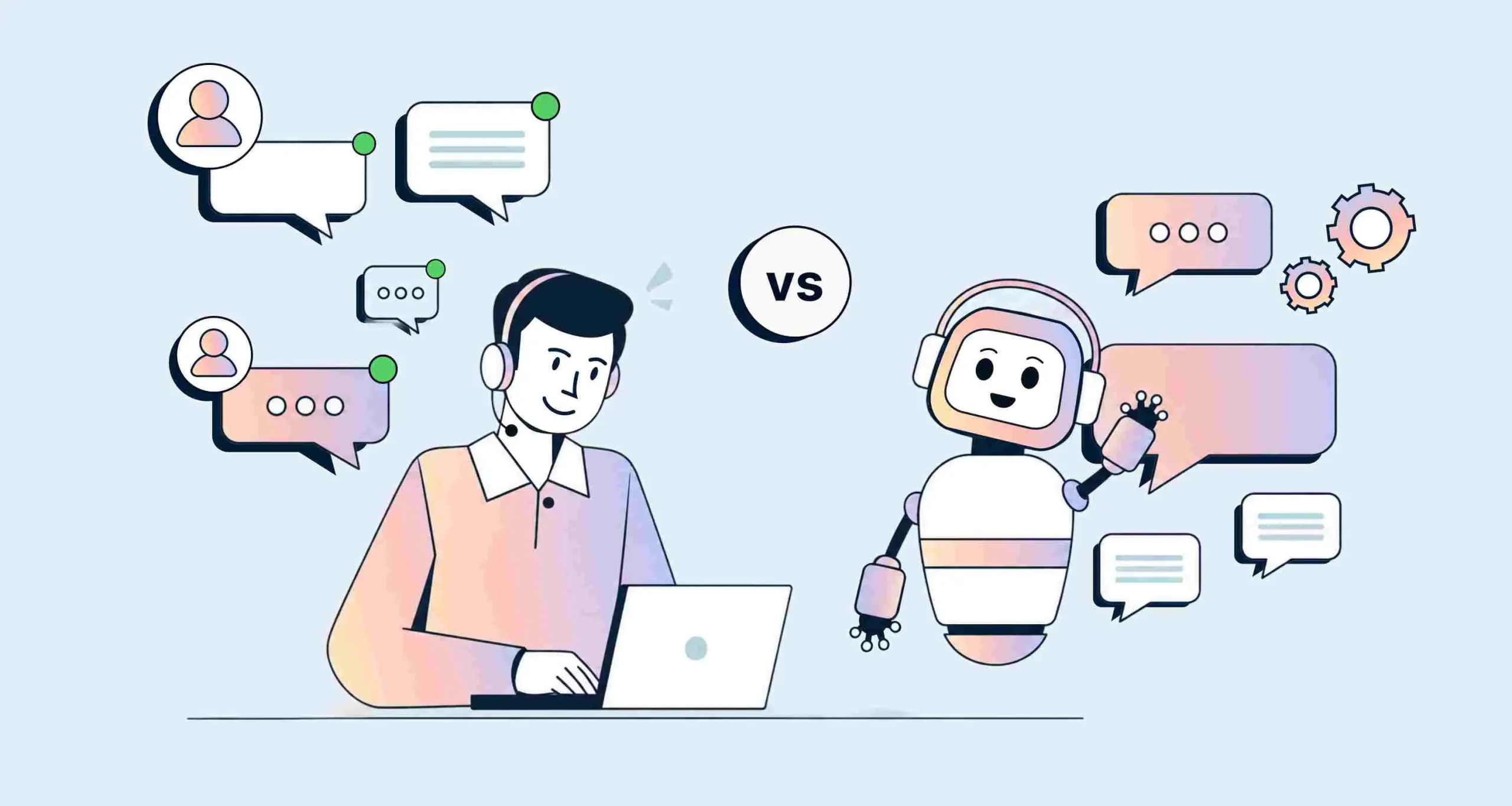
While both chatbots and live chat help businesses interact with customers in real time, they differ significantly in how they handle conversations, scale support, and deliver customer experiences.
Chatbot solution
Chatbots handle routine inquiries, provide 24/7 assistance, and escalate complex issues to human agents.
Modern AI chatbots can collect information, guide customers through workflows, and operate across multiple support channels.
The best AI chatbots for customer service use natural language processing and machine learning to improve response accuracy and scale support.
Live chat solution
Live chat support is a real-time communication tool that is available on a company’s website or through a dedicated chat application.
This allows clients to communicate with customer service teams through a text messaging system.
Live chat may be quickly improved by combining it with popular messaging apps and platforms like WhatsApp and Facebook Messenger.
Businesses can use live chat software to give customers quick and more personalized responses.
Table summary of live chat vs chatbot
| Aspects | Chatbot | Live chat |
| Response time | Offers instant and automated responses. | Are human-driven, which may have slight delays. |
| Availability | Available 24/7, ensuring that customers receive support at any time of the day or night. | Availability usually depends on agent schedules unless the business provides round-the-clock staffing. |
| Scalability | Handles multiple inquiries simultaneously, although response accuracy depends on its training and configuration. | Support teams can handle several conversations simultaneously, but capacity varies by issue complexity, agent experience, and available tools. |
| Cost efficiency | Reduces support costs by automating routine inquiries. | Requires staffing, training, and ongoing operational costs. |
| Learning and adaptability | Requires regular updates and AI training | Support agents adapt and learn in real time |
| Customer experience | Offers a consistent experience but lacks the human touch. | Offers a more empathetic and personalized experience. |
Key factors to consider when choosing live chat vs chatbot
Selecting a chatbot or live chat solution for your business is one critical decision for which you weigh numerous factors.
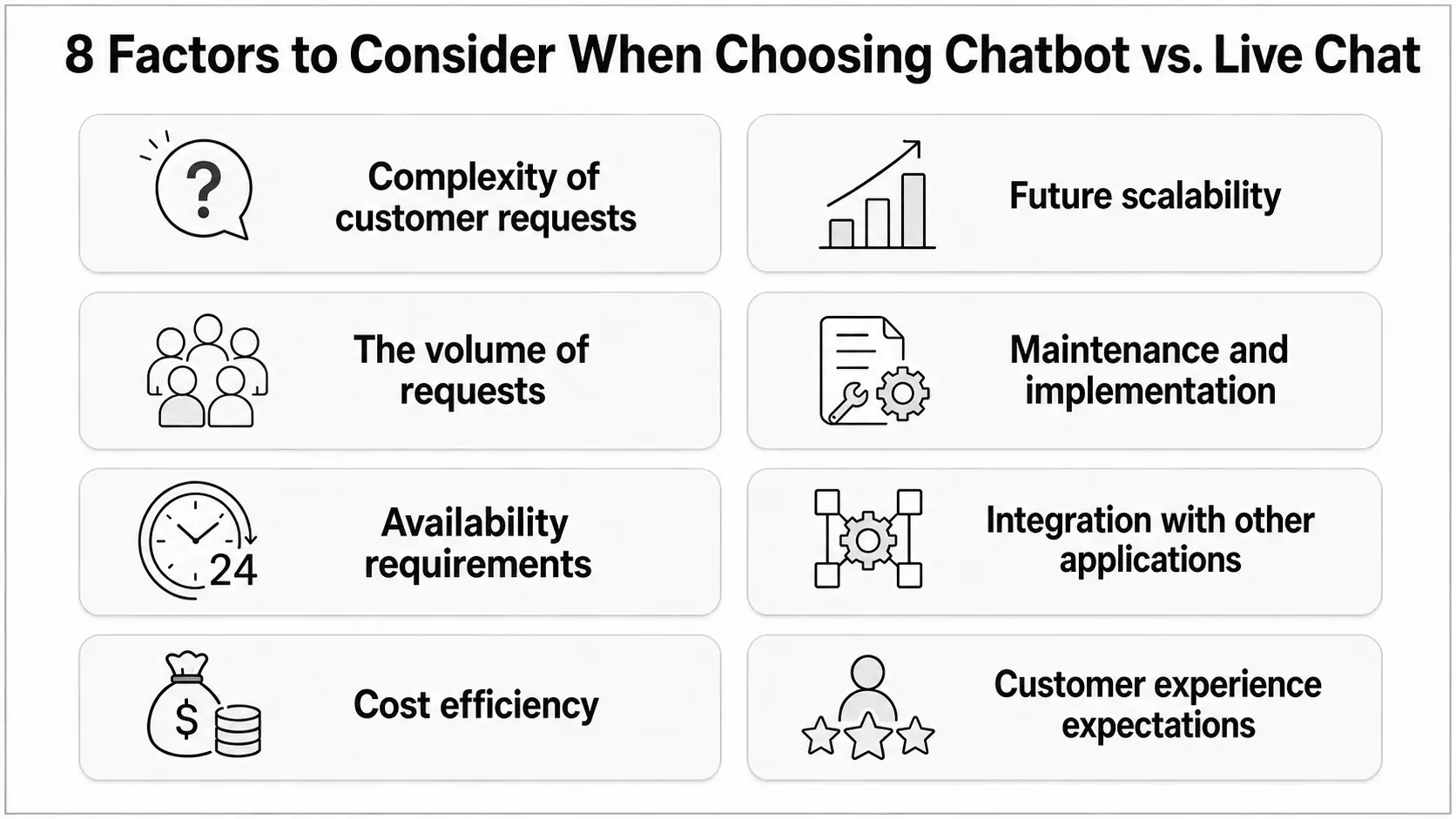
Complexity of customer requests
Understanding the type of inquiries your customers usually have helps set expectations for resolution times and customer satisfaction.
Live chat would likely be more appropriate if your business frequently encounters complex issues requiring detailed explanations and good understanding.
However, a chatbot could be sufficient if most questions are simple and repetitive and can be answered with programmed responses.
Best fit: Choose live chat when customers need detailed explanations, empathy, or human judgment. A chatbot is more suitable for routine questions with predictable answers.
The volume of customer requests
The number of inquiries a customer makes is a huge determinant of your decision.
Basically, at the point when numerous customers are looking for answers to questions, that is where the chatbot does its magic.
They efficiently handle multiple queries without delays, hence offering on-the-spot responses to customers.
On the other hand, if the volume of tickets is low, support agents may be hired to offer more empathetic assistance through a live chat system without feeling there is too much workload.
Best fit: Chatbots are better suited to handling large volumes of repetitive inquiries. Live chat is more valuable when conversation volumes are manageable and customers require personalized assistance.
Availability requirements
Consider the hours during which your customers require support. Chatbots offer 24/7 customer service, ensuring customers find help anytime.
For the automated help desk, chatbots provide instant answers to customer issues.
According to statistics compiled by Adam Connell, 64% of customers consider 24-hour availability a key benefit of chatbots.
Live chat support, on the other hand, mainly relies on the schedule or business hours of the support agents. In addition, it can be 24-hour availability by having support teams work on different shifts.
Best fit: Chatbots provide reliable support for routine questions outside business hours. Live chat is the stronger option when human agents are available, and the issue requires judgment or personalized guidance.
Cost efficiency
Assessing your resources and financial goals will help you determine the best option.
Chatbots can be cheap since they minimize the need for a large customer service team, especially for routine tasks.
The implementation of live chat entails incurring expenses on elements such as installation, onboarding training, and probably integrating some other software for the effective handling of customer interactions.
Best fit: Chatbots can reduce the cost of handling frequent, repetitive inquiries at scale. Live chat may cost more to operate, but the additional investment can be justified for complex, sensitive, or high-value conversations.
Customer experience expectations
The use of live chat support gives the feeling of the service being more human as it allows for more empathy and understanding, leading to better customer relations.
On the other hand, chatbots can respond promptly, but may struggle with emotional or complicated issues that require human judgment.
Knowing what your customers expect may help you choose the right customer communication channel, which will, in turn, help raise customer satisfaction.
Best fit: Choose live chat when empathy and relationship-building matter most. Use a chatbot when customers prioritize immediate answers to straightforward questions. Combining both can deliver speed without removing access to human support.
Integration with other tools and applications
Before implementation, ensure that your chatbot or live chat solution integrates with your existing tools and support systems.
Check out whether your operating system would gain a boost from each method of different operations in the productivity sector.
Nowadays, some chatbots can easily communicate with different platforms, which allows easier sharing of information.
Live chat systems also offer integration abilities, but ensuring compatibility with your current tools may require more effort.
Best fit: Neither option automatically offers better integration. Choose the solution that connects reliably with your help desk, CRM, knowledge base, ecommerce platform, and existing communication channels.
Maintenance and installation
Both chatbots and live chat solutions require implementation, maintenance, and ongoing optimization.
Assessing your maintenance and implementation resources can help you choose the appropriate option for sustainable long-term use.
To raise the effectiveness as well as the accuracy of chatbots, it is necessary to constantly update their scripts and understand the algorithms.
Live chat involves training the agents, and at times, this may force the agents to modify their processes depending on customer feedback.
Best fit: The right choice depends on your available resources. Chatbots require ongoing content reviews, testing, and optimization, while live chat requires agent training, staffing, and performance management.
Future scalability
Finally, make sure you align your long-term growth plans with the possible evolution of your customer service needs.
The great advantage of chatbots is their scalability, which means businesses can increase the number of inquiries handled without the need to regularly increase the number of support teams.
A chatbot can manage more customer interactions as your business grows while maintaining efficiency.
Even though it offers effective personalized customer service, live chat may call for the expansion of the workforce in order to accommodate growth.
Best fit: Chatbots are more scalable for growing volumes of repetitive inquiries. However, a hybrid model is usually more effective when growth also increases the number of complex or high-value conversations.
Advantages and disadvantages of using a chatbot or live chat
The following are the pros and cons of live chat and chatbot solutions to consider before making a choice.
Chatbots
| Advantages | Disadvantages |
| Delivers assistance around the clock, making it easier for consumers to find answers to their questions. | A few percent of customers who prefer standard ways of engagement may find them uncomfortable. |
| Handles multiple conversations simultaneously, making it greater for businesses with high volumes of interactions. | The installation might involve a lot of work in terms of maintenance and implementation. |
| Reduces support costs by automating routine queries while freeing up employees to focus on more complex issues. | May not be adequate to handle complex topics or understand specific requests appropriately. |
| Offers consistent responses and minimizes human errors, allowing a uniform customer experience. | Lacks the empathy and judgment of human agents. |
Live chat
| Advantages | Disadvantages |
| Agents can empathize with customers’ concerns and provide tailored assistance. | Businesses must either manage the live chat feature themselves or employ other support teams to do it for them. |
| Live chat is best for complex questions that need critical thinking. Support agents can better understand these issues than chatbots. | Support teams must be empowered with product knowledge or service to provide good support. |
| Engaging with customers in real time creates opportunities to build trust, which can encourage loyalty. | Managing multiple live-chat conversations can become challenging as inquiry volume and complexity increase. |
| Support agents can provide offline responses by sending emails during offline hours. | Support quality may vary depending on the agent’s experience and communication skills. |
How live chat and chatbot can be used together
Both live chat and chatbots have pros and cons, but they can still work together to provide the best customer service experience possible.
Below are some of the ways in which the live chat and chatbot solutions can be used together to enhance customer service:
Provide immediate responses
A live chat solution allows support agents to work on complex issues and offer personalized and speedy responses to customer questions.
Chatbots can help with this by resolving simple, commonly asked questions or providing basic information any time of the day or night.
When it comes across complex issues, it can act smoothly and hand over the conversation to a live chat agent.
This approach helps in reducing the amount of waiting times while simultaneously ensuring that employees are available for complex challenges.
Ensure 24/7 support availability
As customers need quick responses to their issues, ensure that support is available 24/7.
Businesses should make good use of chatbots to automate customer queries and give immediate answers not only during regular business hours but also at other times.
In cases where live chat support agents are unavailable, the chatbot can escalate complex issues to live agents for solutions during offline hours, providing more personalized and detailed support when available.
Using both live chat and chatbot ensures that customers can always receive assistance regardless of the time, while allowing support teams to focus on more complex tasks.
Customize to address customer problems
Many customers value businesses that provide empathetic and personalized support. If your business uses both live chat and chatbot solutions, use chatbots to gather useful information about a customer-facing problem.
After finding what the problem or issue is, you can utilize live chat support to help the live chat agent deliver more personalized customer service without the customer realizing it.
Manage ticket volume
The number of support requests can be overwhelming at times. To better handle these requests, start by employing chatbots to address many repetitive customer inquiries at the same time.
In addition, ensure you guide customers to the live chat session and allow them to get answers to their questions by providing links to resources like a knowledge base software, FAQs, and step-by-step guides. This will result in increased ticket deflection.
This will let consumers finally resolve their needs more quickly on their own, allowing support agents to concentrate on more difficult issues, especially during busy periods.
Offer seamless transition
When shifting from chatbot to live chat, make sure there is a smooth movement to remove any disruptions in communication.
For instance, if the customer’s request needs human interaction, live chat professionals will then take over efficiently from the chatbot.
This switch between live chat and chatbot ensures immediate and continuous customer service without any possible obstacles.
Track customer interactions
In order to monitor customer engagement, companies should use key performance indicators (KPIs), such as response time, resolution time, agent performance, and customer satisfaction levels.
With the chatbot tools, you can help generate real-time reports with the most common customer issues and offer insights into the causes, and also provide answers.
Once the support teams are available, the conversations can be transferred to a live agent. The agent can carry on with monitoring customer service KPIs, giving a comprehensive representation of the customer support operations.
Tracking these metrics helps businesses identify support gaps and improve the performance of both chatbots and live chat.
The table below recommends the best approach based on common business scenarios and customer service needs.
| Business scenario | Recommended approach | Why |
| Startup with limited support resources | Chatbot | Chatbots can handle routine inquiries around the clock without requiring a large support team. |
| Small business with moderate support volume | Chatbot + live chat | Chatbots manage common questions, while agents can provide personalized support when needed. |
| Ecommerce business | Chatbot + live chat | Chatbots assist with order tracking and FAQs, while live chat helps resolve complex purchasing and support issues. |
| SaaS company | Chatbot + live chat | Chatbots can automate onboarding and common support requests, while agents handle technical and account-specific issues. |
| Enterprise support team | Chatbot + live chat | Large support operations benefit from automation at scale while maintaining human support for complex cases and escalations. |
| High-touch consulting or professional services | Live chat | Personalized interactions, relationship building, and tailored guidance are better handled by human agents. |
How BoldDesk supports live chat
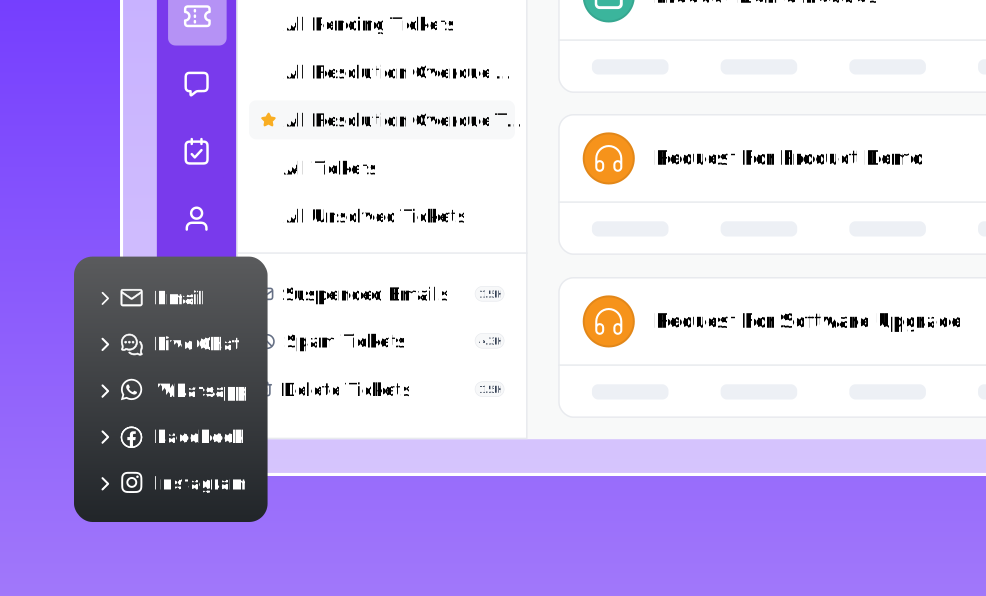
BoldDesk supports live chat across websites and mobile apps. Teams can route conversations to available agents, convert chats into tickets, share conversation histories by email, and provide updates on ticket progress.
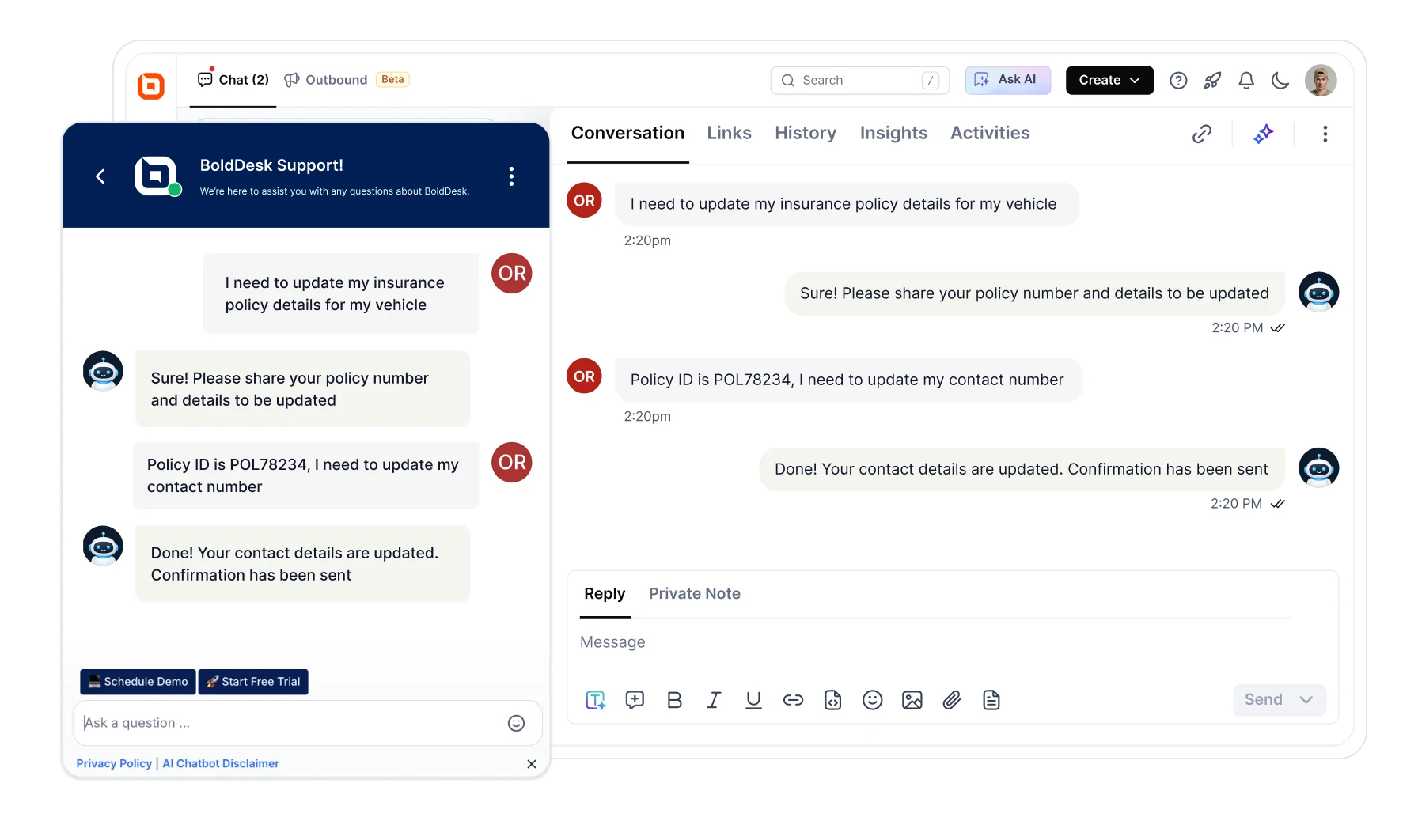
Support teams can also manage WhatsApp and Facebook Messenger conversations alongside live chat. When no agent is available, offline messages are saved as tickets for later follow-up.
For common questions, BoldDesk AI Agents can respond first and hand the conversation to a human agent when needed.
What is the best support channel for your business: Chatbot or live chat?
The ongoing debate between chatbot vs live chat has yet to be resolved. Making the appropriate selection depends on the specifications of your company.
The measurability of live chat and chatbot comparison is realized. It is possible to create a project that combines live chat and chatbots through an assessment of the benefits and drawbacks of each.
Chatbots are quick to handle and provide immediate responses to some straightforward inquiries from customers. They can even provide solutions to issues during difficulties.
However, complicated problems that require human involvement are best left to live chat. The support teams establish a strong connection that finds the ideal balance of live chat and chatbot to provide the highest level of customer happiness.
Talk to us over a 30-minute live demo to see how BoldDesk can transform your customer service with simple and instant responses, or start a 15-day free trial today.
Did you find this article on chatbot vs live chat helpful? Provide your ideas in the comments section below.
Related articles
FAQs on chatbot vs live chat
Chatbots are most effective when speed and efficiency are higher priorities than human interaction.
Use a chatbot when you need 24/7 support, instant responses, and scalable handling of repetitive inquiries such as order tracking, appointment scheduling, password resets, and FAQs.
Live chat is the better choice when customers need personalized assistance, complex troubleshooting, or sensitive issues resolved.
It is especially valuable for high-value sales conversations, billing concerns, escalations, and situations where human judgment is required.
No. While chatbots can automate routine tasks and answer common questions, they are not designed to handle every customer interaction.
Most businesses use chatbots to support agents rather than replace them, escalating complex conversations to human representatives when necessary.
Businesses handling mostly repetitive inquiries can start with chatbots. Organizations that rely on relationship-driven support may benefit more from live chat.
However, most growing support teams achieve the best results by combining both, using chatbots for routine requests and live agents for complex conversations.